How to Read and Display Html Page in Response Body in Golang
Processing Form Request Data In Golang
A request in HTTP is more only an education to the server to answer with information for the resource uniquely identified by the request'south url. Aside the url, a request object has headers and optionally, a body among many other things.
The headers are key-value pairs of information exchanged between the client and the server in either directions of the HTTP request-response cycles. Both the client and the server are able to transport meta-data packaged every bit key-value pair entries into headers. One of the near mutual headers in HTTP is the "Content-Blazon" header which indicates to the receiving end (can be either client or server) how to procedure or parse the request/response torso. Enough has been said about headers but hey, that's not our focus of today. Allow'southward talk about request trunk.
And, if you beloved my posts on Golang, then do well to subscribe to my Become Chop-chop class on Youtube to become notified of the latest videos I post every other mean solar day.
HTTP Request Trunk
As indicated in the text above, HTTP requests can optionally send data to the server in many forms. JSON, Url Course Encoding, Raw Stream Of Bytes are the mutual encoding formats used to send request body data to backend servers. Meet my story on handling json request body in golang if that'southward what you're interested in. HTTP clients and servers largely depend on the "Content-Blazon" header to determine how to parse request/response body. Common values for the "Content-Type" header are application/json, application/cantlet+xml, awarding/pdf, application/octet-stream, application/x-www-class-urlencoded for stating that asking/response body should exist processed as JSON, XML, PDF, Raw Stream, or Form Data respectively. Mod RESTFul APIs favor JSON over XML encoding for both asking trunk and response body because it is computationally easier to parse, and aesthetically easier for humans to read and understand JSON. However, in traditional monolithic web applications where data substitution between client and server isn't done through APIs, HTML form is the goto technique for data exchange. To this issue, HTML forms are very important in modernistic web development and beingness able to parse request body encoded as application/x-www-class-urlencoded is a cardinal feature required of any self-respected spider web framework. One of the reasons why I beloved Golang is the fact that I tin create consummate web applications without relying on tertiary-party libraries or frameworks. Frameworks are built to amend developer productivity by abstracting abroad mundane and repetitive tasks so that developers can focus on implementing core business solutions. As much every bit frameworks can boost your productivity, they can also get in your way and then choose them wisely. Thank goodness, frameworks aren't needed much in Golang. Have I talked too much? May be yes! only no worries, we'll code presently. Stay with me!
URL Information Versus Form Encoded Body Data
Yeah, you read this paragraph'due south title right! Request data tin can exist sent either through the url (normally known as query parameters) or the request body. Nosotros will discuss how to cull between the two earlier nosotros terminate but believe me, 99.99% of forms in your web applications volition be url-encoded and sent in the request body instead of the request url for obvious reasons. Information sent in the url is seen by users so sensitive information such as user account credentials, access tokens etc should non exist sent in this manner. When in doubt, I suggest you cull url-encoded body.
Processing Request Information In Golang
Have you been waiting for this section? I bet you lot have! Ok, allow's get awesome!
Parsing both url and body request data in Golang is very piece of cake just also very tricky if things aren't done in the right society. Lemme give you lot the secret recipe here:
- Always gear up content blazon to application/x-www-course-urlencoded if-and-just-if y'all want to process request body every bit class-encoded data. This is very of import. Adhere to it, thank me later. Even so, note that one time your HTML course's method is set up to "POST" or "PUT", this will be washed for yous automatically.
- Always invoke ParseForm or ParseMultipartForm on the request object in your handler before attempting to read url or body information from the request object. Note : call ParseMultipartForm if your form supports file upload else, ParseForm volition do only fine.
According to the golang documentation on the net/http packet, the following are truthful :
ParseForm populates r.Form and r.PostForm.
For all requests, ParseForm parses the raw query from the URL and updates r.Grade.
For Mail, PUT, and PATCH requests, it too parses the request body as a grade and puts the results into both r.PostForm and r.Form. Asking body parameters take precedence over URL query cord values in r.Form.
For other HTTP methods, or when the Content-Blazon is not application/x-www-form-urlencoded, the request Trunk is not read, and r.PostForm is initialized to a non-cipher, empty value.
If the asking Body's size has not already been express by MaxBytesReader, the size is capped at 10MB.
ParseMultipartForm calls ParseForm automatically. ParseForm is idempotent.
When in doubt, ever consult golang'due south splendid documentation. This is as well a reason why I'll choose golang anytime.
Talk Is Inexpensive, Prove Me The Code
Finally! Finally!! Finally!!! We're here to get our easily dirty with code. In this sections, I will prove you how to procedure request information sent in the url and also the body.

In the cocky-documenting snippet shown above, I iterate over the r.Form object to read information passed through both the url and asking body. Note again that I invoked r.ParseForm() earlier attempting to read form values. The rationale is clearly spelt out in the net/http documentation here.
The shots below show how to hitting the /signup url on the server with postman and the corresponding response logged on the server's console.
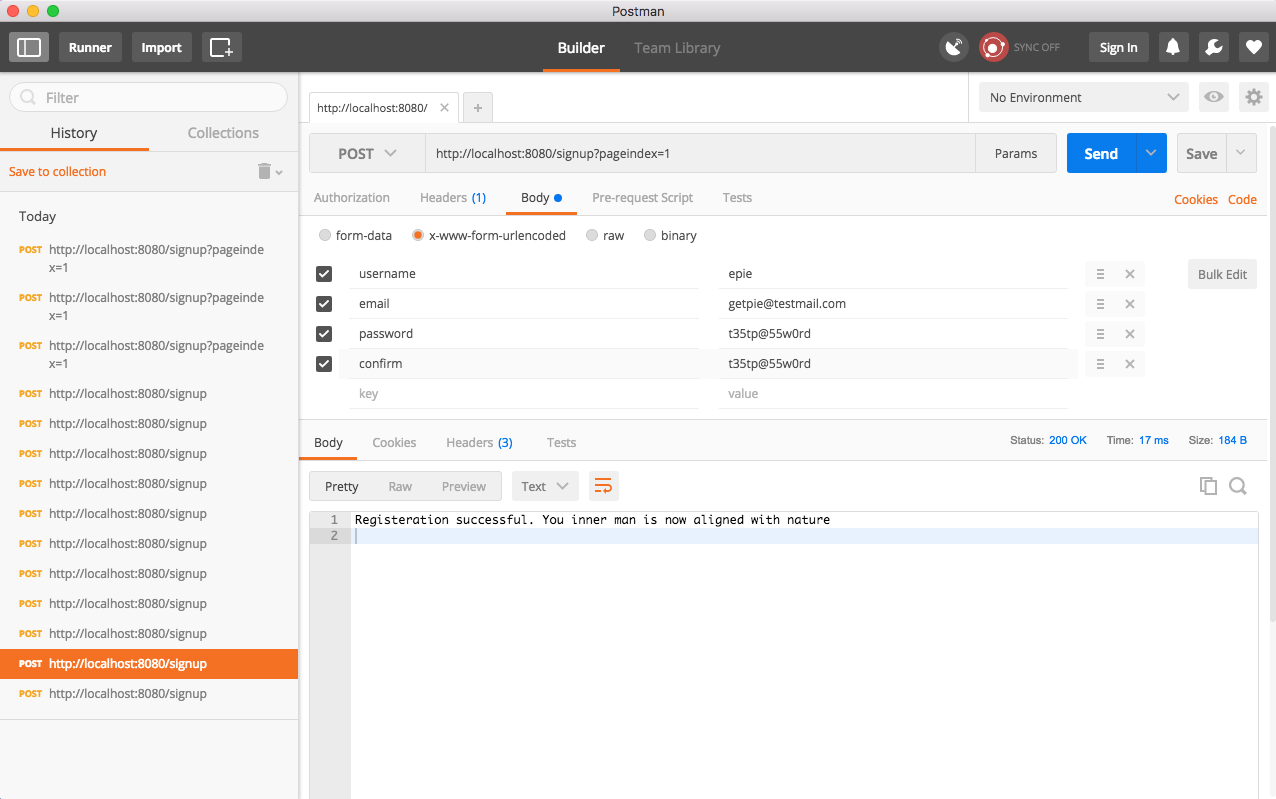
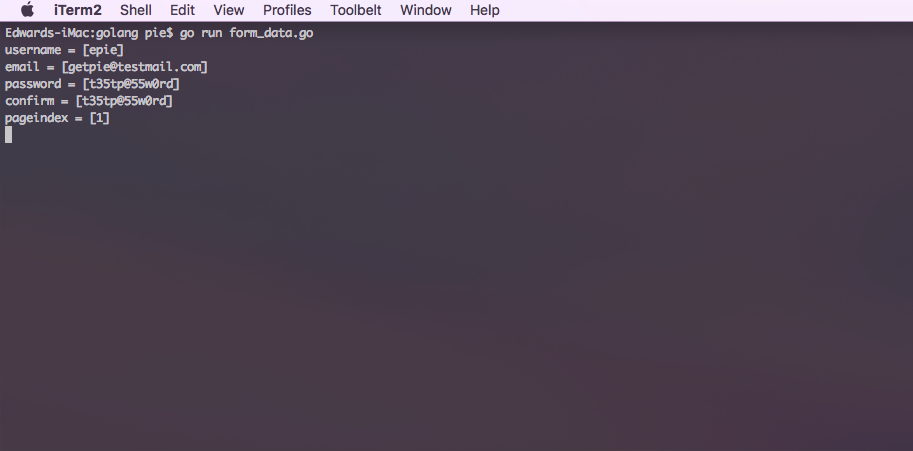
Annotation from the postman screenshot to a higher place that pageindex=one is appended to the url after the ?. This is how to pass data through the request url. Multiple query parameters are cardinal-value pairs separated by &. Also note that though pageindex is a query parameter, it is also readable from the r.Form object, hence it's printed in the panel.
In the snippet below, I demonstrate how to read individual values from the r.Grade object instead of looping through it every bit demonstrated in a higher place.

Extra Notes
Virtually of my examples are simple because the focus is to help yous understand the concepts. Once you've an understanding of how things work, you lot're only limited by your imaginations and creativity. You can access the lawmaking from my github repo here.
Instead of but printing out the individual fundamental-value pairs equally demonstrated in my snippet, you'd rather assign them to fields in structs which volition eventually be persisted to some database for permanent storage in a existent application.
Too, though I used postman to test, this approach nevertheless works when you create HTML forms and assign appropriate names to input fields in the class.
Finally, if you lot love my posts on Golang, and then exercise well to subscribe to my Go Apace course on Youtube to get notified of the latest videos I post every other day.
Thank you for reading!!!
davistwouldes1954.blogspot.com
Source: https://medium.com/@edwardpie/processing-form-request-data-in-golang-2dff4c2441be

Post a Comment for "How to Read and Display Html Page in Response Body in Golang"