what do i need to have a christian passover meal
Introduction to a Christian Seder
Recovering Passover for Christians
The Festival of Passover - Christian Passover - Explanation of Terms and Symbols -
Preparation for the Seder - The Traditional Steps of the Seder - A Christian Seder Haggadah -
Boosted Ways to Tell the Passover Story - Recipes
The Festival of Passover
Passover is the oldest and nearly important religious festival in Judaism, commemorating God's deliverance of the Hebrews from slavery in Egypt and his creation of the Israelite people. Passover is actually composed of ii festivals, The Feast of Unleavened Bread and Passover (which is sometimes used to refer to the single twenty-four hour period and sometimes to the entire span of both festivals).
The festival of Passover, known as Pesach, begins at sunset on the 14th of Nisan (usually in March or April) and marks the get-go of a 7 day celebration that includes the Feast of Unleavened Bread. -i- The focal point of Passover is a communal meal, called the Seder (which means "order," because of the fixed order of service), which is a time of rejoicing and celebration at the deliverance for the Hebrews that God achieved in the exodus. Sometimes the meals during the entire period of Passover and Feast of Unleavened Breadstuff are referred to as Seder meals, chosen the first Seder, the 2d Seder, etc., although commonly only the offset two nights are considered Seder meals.
Dissimilar the near Holy days of Christianity that are observed in Church, since the destruction of the Jerusalem Temple in AD 70 Passover has been celebrated in the home with family and friends as they swallow a meal together. It is customary to invite guests to share the Seder repast, especially newcomers to the community. The bodily Seder meal in about Jewish homes is an elaborate feast, with nutrient, games for the children, and plenty of time to tell the story of the Exodus from Egypt. It is not unusual for a Seder to last 3 to four hours.
The Seder involves everyone nowadays since they all accept a Haggadah (Heb: "telling," the printed order of service, reading, and songs) and are called to share in reading and singing the story. While the father or gramps is usually the leader of the service, others have roles as well. The mother of the home lights the festival candles that indicate the beginning of Passover, the youngest kid asks the four questions, the children help eliminate all Chametz, leaven, from the house, search for the subconscious Afikomen (a symbolic piece of Matzah, unleavened staff of life) and open the door for Elijah, the parents or the grandparents tell the story of the exodus, and various others are designated to read or lead certain portions of the service.
Passover is really more than a festival. It is an elaborate teaching experience, particularly for the children, intended to call people to their identity as the People of God. By using all of the senses, the Passover Seder tells the story of God's grace in history and calls the participants to experience and share in the story as their own story. Passover becomes more than than but a service or a time; it becomes a way to confess faith in the I who has acted in history, and for Jews expresses the promise that He volition continue to act in bringing deliverance to all people everywhere.
The Feast of Unleavened Breadstuff (Heb: matsoth; transliterated in diverse ways as Matzot, Mazzot for the plural form, or Matzoh, Matzah for the singular, or simply Matzo) is a seven twenty-four hour period festival that is actually a part of and continuation of the Passover celebration. It actually begins on the 15th of Nisan in the Jewish calendar and lasts until the 21st, although as early as Josephus in the 1st century BC the entire festival was counted equally eight days (Antiquities, two:15:1). In training for Passover, all chametz or leavened food (food with yeast) is removed from the house and cannot be eaten during the seven days of the Festival. The unleavened staff of life symbolizes the haste with which the Israelites had to flee from Egypt. Since they did not have time for the bread to rising in order to have provisions for the journeying, they had to bake it without yeast (Ex 12:xi, Deut 16:three).
The second night of Passover (the 2d Seder) is celebrated as the First Day of the Omer (an omer is a sheaf of barley), since on this night an omer was brought to the Temple as an offering. This reflects the likely origin of the Banquet of Unleavened Bread equally an agronomical celebration that the Israelites adjusted from the surrounding Canaanites marker the beginning of Spring barley harvest. Some elements of the Passover itself may take had origins in the pastoral culture of the Middle East in observing the Leap birthing of livestock. Throughout history, Jews and Christians alike have adopted and transformed secular and pagan celebrations and used them to limited their own faith confessions.
However, the origins of the festivals are really immaterial to their celebration within the community of Faith. The fact that in Scripture the two festivals are always linked as a memorial to the exodus suggests that whatever the origin, the Israelites combined the festivals very early in their history. The origins are of import to students of Scripture and history, but exercise non really bear upon the festival every bit a commemoration of God and religion.
The First Day of the Omer begins the 49 twenty-four hour period countdown (7 weeks of vii days) to the commemoration of Shavuot, known in the Old Testament as the Feast of Weeks or in Christian Tradition as Pentecost (50 days, counting from the first nighttime of Passover). The period between the two festivals is know as the Days of the Omer, and serves to necktie the two festivals together into a flavour of sacred fourth dimension.
While originally an agricultural festival celebrating the beginning of the wheat harvest, in Jewish tradition Shauvot has come to be celebrated as a commemoration of the giving of the Torah at Sinai, a service of thanksgiving for the commandments and instructions past which the Israelites were to alive out in applied ways the implications of being the people of God. By using the Days of the Omer to link Passover and Shauvot, they made obvious the theological link between the grace of God in the exodus and the call to true-blue response and obedience represented in God'due south gift of the Torah.
The last twenty-four hour period of Passover is oft treated like a Sabbath, with special prayers and no work done.
Christian Passover
In that location has been increasing interest amid Christians in this ancient festival. There are various reasons for this renewed interest: an increasing sensitivity to cultural and societal problems and a corresponding desire to learn nearly others; a renewed sensation of the importance of the Quondam Testament Scriptures as Christian Scripture; a desire or fifty-fifty a need in our mod world to recover a sense of the sacred through liturgy and sacrament; the willingness to detect new and innovative ways to worship; and perhaps even the enjoyment that comes from acknowledging the continuity with a three,000 year old community of faith.
As a result, there has been an explosion of involvement in adapting the Passover festival to Christianity. Various organizations, such every bit "Jews for Jesus," have long promoted Christian Passover services equally a ways for Jews to retain their cultural heritage while confessing Christian faith. They have also used the Christian Passover as a means to communicate to Christians the Jewish religious heritage that they value.
Our goal here in presenting a Christian accommodation of Passover is to retain the theological, confessional, and educational dimensions of the service. That is, it is presented as a style for people of Christian Faith to express that faith in the context of a gathered community by participating symbolically in the story of conservancy. Information technology is presented very deliberately and purposefully as a Christian service, with no apologies. Yet, there has also been a deliberate attempt to preserve the spirit of the Jewish traditions and experience in the service, and to respect the faith journey of Israelites and Jews across the centuries. For that reason, apart from the fact that information technology will likely exist Christians who are participating in the service, the thoroughly Christian dimension will come at the terminate of the service. After all, that is really how God chose to work in history: to the Jew first, and then also to the balance of us!
Explanation of Terms and Symbols
afikoman: Greek, "dessert," in aboriginal times the last morsel of the paschal lamb, eaten at the end of the Passover meal. In modernistic times, it is represented by half of the eye Matzah in the ceremonial Seder dish, which, when broken off, is hidden until the end of the meal. Adapted from some Jewish traditions, it also symbolizes the Messiah who volition come to restore all things. In Christian Seders, this becomes the symbol of Jesus the Messiah (Christ), and is used as the staff of life of the Eucharist.
beitzah: "roasted egg," in the Seder meal represents the burnt offerings brought to the Temple during festivals in ancient days; it also symbolizes the cycle of life, the endurance of God's people and the hope for a time to come. Traditionally, a chocolate-brown egg is used on the Seder plate, roasted in an oven until information technology turns dark. Vegetarians oftentimes apply an avocado seed as a substitute for the egg on the Seder plate. While hard boiled eggs are often served every bit the showtime grade of the Seder repast, similar the zeroah the beitzah is not eaten since sacrifices are no longer offered.
chametz: "leaven" or "yeast," the ingredient in breadstuff that ferments and makes the bread "rise"by producing bubbles of gas in the dough. Its absence in Passover carries a dual symbolism. First, the employ of unleavened staff of life symbolizes the haste with which the Israelites had to flee Egypt; 2nd, it is often a symbol of corruption and sin, and so its removal symbolizes the freedom from sin that God brings.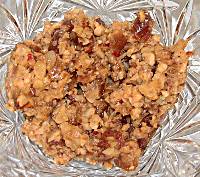
c haroset: derived from the Hebrew word for "clay," a mixture of apples, nuts, cinnamon, beloved, and wine which serves to sweeten the bitter herbs. Because of its advent, it symbolizes the mud mixed with harbinger used past the slaves in Egyptian buildings. However, it's sweet symbolizes that the bitterness of slavery is tempered with the hope for a hereafter. While the maror and matzah are biblical commands, the charoset was an chemical element added by the rabbis.
chazeret: a 2nd bitter herb sometimes used to make the "Hillel" sandwich; often romaine lettuce is used for the 2nd herb.
dodi li: "my beloved is mine," the start words of the traditional reading from Song of Songs (2:16), used as a title for the entire reading.
haggadah; plural, haggadot: from a root which means "to tell," the printed booklet that contains the instructions or order or service, readings, and songs for the Passover Seder.
hallel: "praise," refers both to the section of the Seder in which songs are sung, every bit well as to the songs themselves.
k'arah: a ceremonial Seder plate, sometimes very ornate, that contains places for the five symbolic elements of the Passover Seder: karpas (parsley), lamb bone, bitter herbs, egg, and charoset. On more elaborate plates, additional places are provided for other symbols, such equally a place for a small bowl of common salt h2o. In this Seder plate, space is provided for the chazeret, a 2d bitter herb used to make the "Hillel" sandwich.
karpas: "greenish vegetable," garden greens, usually parsley, celery, lettuce, or other leafy green vegetable such as watercress used in the Seder meal. The greens are dipped in a minor bowl of salt water, recalling the hyssop dipped for sprinkling on the door posts of Hebrew dwellings in grooming for the Exodus (Exodus 12:22).
kashrut: "fitness," the Jewish dietary laws adult from the Onetime Testament and the Talmud; kosher ("proper") identified those foods acceptable to observant Jews. There are a variety of laws governing which foods can exist eaten and how they may be prepared, but the basic restrictions are: (1) no pork or pork products equally well as sure other foods such equally shellfish, and (2) no dairy products served with meat. As well during Passover there tin be no food eaten that is made with yeast, blistering powder, or baking soda. Today, many commercial foods are marked in various ways (for instance, with a "K") to betoken that they are kosher.
kippah: also known equally a yarmulke, a close fitting hemispherical head roofing or cap worn as a sign of reverence and respect for God. Traditionally worn just past men it is now occasionally worn by women in Bourgeois and Reformed groups. Information technology is often worn during the Seder, especially by the leader.
maggid: "telling," the section of the Seder in which the story of exodus and Passover are recited in various ways.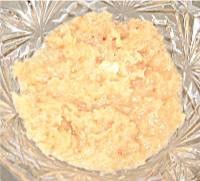
maror: "bitter herb," traditionally a piece of horseradish root or romaine lettuce. A reminder of the bitterness of life in bondage, non just in Egypt, merely everywhere. In the Seder meal, grated horseradish is usually used (at right).
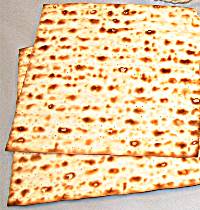 matzah; plural, matzot: "unleavened staff of life," dough made without yeast that bakes into a thin flat bread. Biblical tradition says that the Hebrews had to leave Egypt and so quickly that they did not have time to let the bread rise so they made the dough without yeast or leaven. It is possible that they took the dough with them in kneading bowls and sun baked the bread on the hot rocks of the desert. There are various ways to transliterate this term. Today, Matzah is represented by apartment cracker-like wafers. In the Passover Seder three Matzot are used, two representing the 2 loaves of bread that were placed in the Jerusalem Temple on festival days, plus an additional one for Passover.
mitzrayim: "Egypt," although the origin of this Hebrew discussion is uncertain, some see it derived from the Hebrew word tzar (narrows, straits), meaning "from the narrows" or "from between the two sides." With this agreement, some use the proper noun Mitsrayim rather than Arab republic of egypt in the Seder equally a more generic symbol of persecution and oppression.
nirtzah: "acceptance," the concluding section of the Seder marked by a prayer that the service will be accepted and the drinking of the last cup.
pesach: "passover," used to refer to the entire Passover festival or more specifically to the Passover lamb. In the Seder, it refers to the roasted lamb shank os that represents the sacrificial Passover lamb (Exodus 12:21-27).
seder: "society," refers both to the service of the Passover festival meal that follows a prescribed gild, and to the entire festival meal itself.
tzafun: "subconscious," refers to the "dessert" of the meal, which is a piece of Matzah that has been subconscious (the Afikomen).
yom tov: "good day," used to hateful "festival."
zeroah: "arm," the roasted shank bone of a lamb that is symbolic of the Passover lamb, both the lambs that were killed in Arab republic of egypt for the first Passover, just likewise for the sacrificial lambs offered in the Temple to commemorate Passover. Some Jews understand the bone too to symbolize the arm of God outstretched to help his people in times of trouble. Since there are no longer Temple sacrifices, no lamb or any other roasted meat is eaten at Passover. Some households use a chicken cervix in place of the shank bone, and vegetarians often use beets to supervene upon the shank bone on the seder plate, with the carmine beets and juice symbolizing the blood of the lamb that was used to marker the door posts of the houses.
Other Items
Elijah's Cup (kos eliyahu ha-nabi): In Jewish observance, this is an extra cup of wine displayed (sometimes at an empty place setting) to welcome the prophet of hope who would announce the Messiah'due south coming. While left empty or untouched in Jewish observance, in the Christian Seder it represents the Loving cup of Redemption, the Passover, "shed for you . . . the forgiveness of sins," and is used symbolically every bit the cup of the Eucharist.
Wine: The traditional symbol of rejoicing. "Wine to gladden the heart of humanity" (Psalm 104:15). Since many evangelical churches maintain an ethical position of total abstinence from alcoholic beverages, grape juice may exist substituted. For a more authentic experience some of the newer carbonated "sparkling" non-alcoholic grape juices can exist used.
Candles: The symbol of God'southward presence at the ceremony. Ordinarily 2 single white candles in candlesticks are used.
Training for the Seder
Preparing for the Seder is important if the service is to run smoothly, especially because that most Christians have not even participated in a Seder let alone planned one. The preparations are non complicated just do need to be given some consideration ahead of fourth dimension. It is usually wise to begin planning and gathering materials at least ii weeks before the actual appointment, merely to permit for unexpected difficulties. Careful thought alee of time will make the feel more than enjoyable for those leading the service.
Different Means to Conduct a Seder
One of the first decisions that must be made is the kind of Seder to be held, which will largely determine the number of people participating, as well equally the amount and type of preparations necessary. At that place are three basic ways of doing the Seder as a Christian service.
Full Meal Seder
The Seder can be conducted as a full course meal, just as information technology is historic in Jewish homes. Notwithstanding, this is usually impractical to do in public with a large grouping, not merely because of the expense, logistics, and piece of work involved, but also considering of the length of the service. A full Seder meal unremarkably takes from 2 to iv hours, depending on the number of songs and children'south activities. Since the Christian Seder is commonly offered equally part of Holy Week services, usually on Maundy Thursday, such a long evening service volition often put a strain on family unit schedules, especially if there are younger children involved.
Usually, a full meal Seder is best done in a home setting with a limited number of people. It is especially appropriate for pastoral or church staff, for a smaller Sunday School form, or simply equally a celebration with family and friends. It is rare in nigh Christian circles for families to exercise specifically religious activities outside of a church setting, and this would be a adept means to address that deficiency. This may really take as much or more planning than a public service, especially if there are many children involved. There should exist plenty of activities included for the children, since the entire service is concerned with telling the story of God to future generations (in improver to the trouble of short attention spans!)
Sit-in Seder
This moves to the opposite stop of the spectrum, in that a Seder is not really conducted but only the diverse elements of the service demonstrated by ane or two leaders. This is almost frequently done for a large group who practice not themselves participate in any of the activities. A demonstration service has the advantage of flexibility and the least amount of preparation, and is nigh appropriate for a Dominicus Schoolhouse class, children's church, or youth group, or perhaps even a Sunday evening service. The main disadvantage is the lack of the participatory feel in community, the main value of the Seder. It is unremarkably a demonstration Seder that is offered to local churches past organizations such as "Jews for Jesus," or that is periodically provided to the public by many Jewish synagogues or temples.
Symbolic Seder
This is a compromise between an bodily full-meal Seder and a demonstration presented by a minor group to an audience. A symbolic Seder usually includes the main elements of the Seder service and the participation of everyone present, but without the full meal, the extended games for the children, and the songs at the conclusion. There are often other aspects of the service that are abbreviated or omitted, such every bit the paw washings. Usually, a symbolic Seder for Christians will be an adaptation of the Seder service to Christian practice. There are various ways to adapt the Seder, ranging from a total reworking of both the guild (seder) and the actual service itself (haggadah) to give information technology a Christian perspective from the starting time, to an attempt to recreate an abbreviated version of the Jewish Seder with few if any Christian elements.
The service presented here is a symbolic Seder that tries to respect and retain the Jewish heritage represented in the Seder, even so clearly defining the service as Christian celebration. For this service, specifically Christian elements are not added into the service until the conclusion, trying to symbolize the way the story of God has really worked out in history ("to the Jews start, and also to the [Gentile]").
A symbolic Seder has the advantage of presenting the main elements in celebrating Passover, as well as allowing everyone to participate in this unique learning and worship experience. As part of Holy Calendar week services in a local church, it too tin be a meaningful way to set for the observance of Practiced Friday and the celebration of Easter. 1 disadvantage to this service is that it does take considerable planning and preparation, although it is not as complicated every bit a full meal Seder. On the other hand, almost any meaningful worship experience takes careful planning, and the uniqueness of this service can involve people who might non unremarkably have a role in planning services of worship.
Gathering the Materials/Table Setting
The post-obit guidelines for planning the Seder are intended to be used with The Passover Seder for Christians presented by CRI/Voice, which is a symbolic service designed to be used in a public setting with participation. If another blazon of Seder is planned, or adaptations of this Haggadah are used, adjustments will have to be made accordingly. (Meet the Preparation sections in the Haggadah for The Passover Seder for Christians for additional information).
How Many?
After the type of Seder is decided, the next step is to gauge how many people will be involved in the service. This is important non only for the physical setup of the service, only also for the material to be purchased or prepared. The following will describe what is needed for the head table and for each place setting as a footing for calculating the amounts needed.
A complication in determining the number of participants involves whether the service will be advertised publicly by newspaper ads, flyers, mailings, or posters, or if it is primarily aimed at a more than restricted group. In some communities, in that location will be a greater appeal for advertizement, and such a service will attract many who would not unremarkably attend services. Of grade, information technology is always best to programme for likewise many than to come up short, but that also involves a delivery of extra time and resource. Again, this is a decision that should be fabricated early in the planning process.
Another issue that also needs to be decided early in relation to the number of people for whom the service is planned is how the Seder is to funded. Some churches sell tickets to such events, either at a fixed toll or for an unspecified donation. Some charge admission at the door, while some defer expenses past an offering taken at the conclusion of the service or donations accepted as people enter. Others simply offer the service equally a ministry of the church with nothing expected from the participants. Which road is taken may as well touch the estimated omnipresence.
Seder Elements for Each Table
These guidelines assume that the layout for the Seder is several small groups or tables of 4-half dozen people in each group, with one person designated a leader of that grouping. This can exist washed without such groups, in which case adaptations could exist fabricated in the table setting and the materials required.
A note about wine: Wine has e'er been an integral part of the Passover ritual even in New Testament times, so much and so that many of the traditional blessings of the Seder refer to the "fruit of the vine." All the same, many evangelical churches have taken an upstanding position of full forbearance from booze, so many will want to utilise grape juice for this service. Carbonated "sparkling" grape juice is widely available (red grape juice, not clear, should be used).
The Head Table
The head tabular array is commonly situated at the front of the room where everyone tin run across it conspicuously. If possible, it is best to suit the room and so that everyone will be facing the head table, for instance, in a "U" shape. If this is non possible, tables may be angled and so that the most number of people have a clear sight line to the head table.
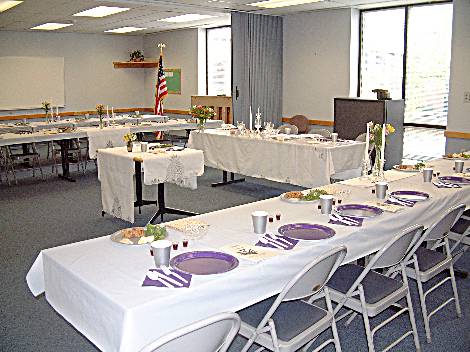
The head table should be large plenty to seat 3-4 people (the 2 main leaders, one human and one woman, and 1 designated to atomic number 82 the "People" readings). It should likewise be able to agree all the elements of the Seder without existence crowded. Usually, a half dozen-8 human foot folding tabular array is best. Information technology should be covered with a white tablecloth; this can be a inexpensive roofing, since the gamble of stain is high, simply a material that covers the acme and virtually of the forepart will help establish the ceremonial nature of the service. A white linen tablecloth tin be covered with a sheet of articulate plastic for protection (see photograph beneath). It will facilitate the service to have microphones at this table.
Place Setting for the Leader
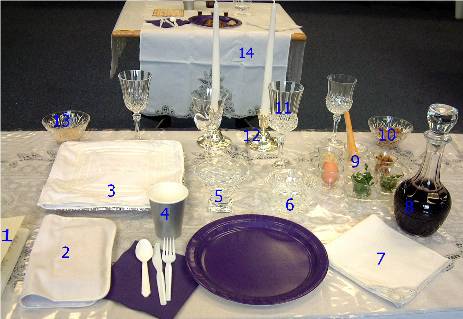
These are the bones elements for the leader: ane) a leader's copy of the Seder Haggadah; 2) a special linen napkin with a pocket to hold the afikomen; 3) a linen bag with three compartments for the matzot, here placed on a special silverish matzah plate; iv) a cup of drinking h2o; 5) a bowl of water for the ceremonial paw washing; six) a bowl of common salt water; 7) a napkin or towel; viii) carafe of vino or grape juice; nine) the Seder plate; x) a basin of charoset; 11) four glasses, one for each of the cups (a single drinking glass tin can be used); hither Elijah's cup is slightly larger; 12) 2 candlesticks with white candles; thirteen) a bowl of grated horseradish; 14) a tabular array with a place setting for Elijah (optional).
In addition to all the elements for individuals and for the group listed above (identify settings for each person at the head table), you volition need the following for the head table.
Elements needed for the Caput Tabular array:
1 vi-eight ft. folding tabular array
white tablecloth
1 Seder plate
a particularly decorated plate with places for the symbolic elements used by the leader. This is important in a traditional Seder meal; some stores, or fifty-fifty a local synagogue or temple, oftentimes sell inexpensive plastic or paper Seder plates
a leafage of Romaine lettuce
this is only necessary if the Seder plate has a place for a second bitter herb; it is not used in this service
1 slice of raw horseradish root
this is placed symbolically on the Seder plate, but is not actually used in the service since grated horseradish is used; a teaspoon of the prepared horseradish can exist used on the plate instead
a Matzah bag or cover (optional)
four clear wine glasses
it is effective to have rather ornate crystal glasses for the Leader, a different mode for each cup; these should be fairly large
1 loaf or several slices of regular, raised bread
pieces of this will be hidden and all of it removed before the Seder begins
ane hard-boiled egg
this should be either a dark-brown egg, or roasted in an oven until it turns brown
ane lamb shank bone
these tin can unremarkably exist obtained from a local grocery store
Afikomen prizes
the blazon and number of these volition be determined past how the search for Afikomen is conducted, and whether a prize is given to each child; often coins of State of israel are given as prizes
A Leader'southward Haggadah
this is simply an expanded version of the aforementioned Haggadah used by the people, except with additional instructions and notes; if this is non bachelor, the leader should review the Haggadah well before the service and make any notes necessary
3 clear bowls
the Leader'southward bowl of Charoset, Salt Water, and Maror should be clear so that the participants can come across their contents when they are held upward; a small, articulate custard bowl is ideal
a pitcher or basin of h2o
an empty basin
a mitt towel
Place Setting for Each Person
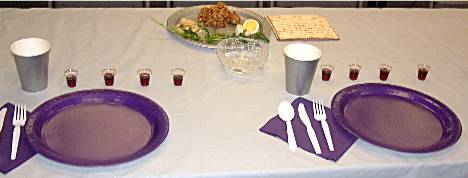
In this place setting, the elements for the Seder are on a separate plate to be shared by two people. Eggs were also used, although in a typical symbolic Seder they are not. Rather than having a vino drinking glass and filling it for each cup, iv modest pre-filled communion cups were used. The cup for the salt water is inexpensive articulate plastic.
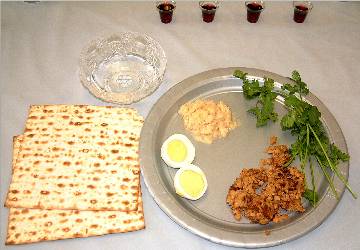
There are the basic elements needed for a symbolic Seder: from left clockwise, Matzah, a basin of common salt water, wine or cherry-red grape juice, hard boiled egg (optional), grated horseradish, parsley, charoset.
Elements Required for Each Person:
i dinner plate
paper plates are OK, but they should exist the better quality "Chinet" blazon
1 napkin
to make this a special occasion, if possible linen or cloth napkins can exist used
1 vino glass
this should be clear, non a paper cup; very cheap articulate plastic wine glasses are commonly available in many stores. Information technology is also possible for each person to to have four small clear plastic communion cups of wine, already filled earlier the service; if this is washed, then the wine carafe is not needed for each group.
1 h2o glass
this is a precaution for those who might become likewise much Maror and need a beverage. This drinking glass can be filled with water, or left empty and filled from the water pitcher if needed
ane fork and i spoon
plastic is fine, although regular flatware will aid mark this as a special occasion
i sprig fresh parsley
this can be placed ahead of time on each individual plate, or tin can be placed in a larger bowl and passed around at the appropriate time
i full piece of Matzah
usually a 6" square piece. This assumes that each group leader will have the 3 pieces used in the service; it is besides possible for each person to accept 3 pieces of Matzoth, although that becomes a little more expensive. Most larger nutrient stores volition take Matzah available in the Leap, or tin order it. It comes 10-12 pieces to a box.
one pocket-size bowl of table salt water
there should be enough common salt water in which to dip the parsley, and enough table salt in the water to make it cloudy (an alternate organization would have a small basin for every four or five people to share).
ane re-create of the Seder Haggadah
Songbook or printed handout of songs
If the hand washing is to be included as a public action:
1 small towel
for the corporeality of water used, a wash cloth may be used as a towel
Elements required for each grouping:
2 white candles in candlesticks
1 small bowl of Charoset
there should exist more than than enough in each basin for each person in the group to have virtually ii tablespoons (this can be placed on individual plates before the kickoff of the Seder to salve time).
1 pocket-size bowl of prepared, grated horseradish
there should exist more than enough in each bowl for each person to have almost 1 tablespoon; hot variety is better (this can exist placed on private plates before the offset of the seder).
five white fabric napkins
for the Matzah basket
one large plate or shallow basket
for the Matzah
3 total pieces of Matzah
placed on a napkin covered plate or basket each separated past a single white cloth napkin, with the top i as well covered by a napkin.
1 carafe or pitcher of wine
1 pitcher of drinking water
Table ornamentation
fresh bound flowers contributed past members of the group are constructive reminders of the newness that this celebrations represents
If the hand washing is to exist included as a public activeness:
1 pitcher of water (or a basin of h2o with a pocket-sized dipper)
ane empty shallow basin
A Community Event
In planning for the Seder, consideration should exist given to the concrete set up-up for the service. While the normal setting upwardly of tables, sound organization, and make clean-up are rather routine for any such public service, some boosted assist will most likely be needed for the unique aspects of this service. Involving others in the preparation and setup of the service is in keeping with the communal nature of the event, and can itself be office of the excitement of the celebration.
In terms of preparation, someone will need to be in charge of figuring out how much of which items are needed and to supervise purchasing the necessary food and utensil items for the service. Almost churches take someone who is willing to have responsibility for decorations, which in this case would involve purchasing, collecting, or coordinating the donation of fresh flowers to be used for tabular array decorations, likewise equally any other decorations desired. And of grade, someone will have to cook or gear up the Charoset, which in a symbolic Seder is really the merely nutrient particular that needs to be prepared (in addition to the single hard-boiled egg for the Seder plate).
The Leader of the Seder should exist chosen early enough that due south/he can participate in the planning and coordination of the service, and supervise the final identify settings for the service. The Leader needs to be familiar enough with all the details of the service to be able to facilitate information technology hands and smooth over any problems that might ascend. Other readers and participants should exist given copies of the Haggadah early enough to be thoroughly familiar with the readings so that they flow smoothly.
The Traditional Steps of the Seder
The seder (order) of the Seder traditionally took fourteen steps beginning with the first cup of vino. Even though the removing of leaven is not considered function of the actual Seder, since information technology takes place before the Seder begins, a symbolic search for leaven is unremarkably incorporated as preparation for the service.
- Bedikat Chametz
Search for leaven
- Hadlakat Ha-Nerot
Lighting of the Passover candles
- Kaddesh
Sanctifying blessing and first cup of wine
- Urchatz
First hand washing
- Karpas
Green Vegetable dipped in salt water and approving
- Yachatz
Breaking the middle Matzah and hiding the Afikomen
- Maggid
Telling the story of Passover and the 2nd cup of wine
- Rachtzah
2nd hand washing and approving
- Motzi/Matsah
Approving for the bread and eating of Matzah
- Maror
Eating of the bitter herbs
- Korech
Eating of sandwich of Maror and Matzah
- Shulchan Orech
The festival meal
- Tzafun
Eating the Afikomen
- Barech
After repast approving, the third loving cup, welcoming Elijah
- Hallel
Songs of praise
- Nirtzah
Fourth cup and completion of the Seder
A Christian Seder Haggadah
Due to the length of the Haggadah, information technology is provided on a separate page: A Christian Seder Haggadah
Boosted Ways to Tell the Passover Story
There is a great deal of inventiveness in how the Passover story is told in the Seder. The goal is not simply to echo the story in the same way yr later year, merely to teach the content of the story as a ways of forming identity with the customs. That results in literally thousands of dissimilar Haggadot that vary in how the Passover story is told.
Commonly, there are iv major ways of telling the story during the Seder: 1) The 4 Questions, 2) the Four Children, 3) the Passover story, concluding with the reading Dayeinu, "It would have been enough," and iv) the explanation of the Passover symbols on the Seder plate. The Christian Seder given here combines The 4 Questions with the explanation of the Passover symbols on the Seder plate to answer the questions and tell the Passover story. Following are other means of telling the story and other features that can be incorporated into a Seder.
Four Attitudes Toward Passover
This begins with the observation that the command to "tell your children" the Exodus story occurs four times in the Torah. The Talmud (Jewish rabbinic commentary on the Old Attestation Scriptures) suggests that the reason for this fourfold instruction is that in that location are four different attitudes that could exist exhibited in approaching the Seder, represented by four children or iv different kinds of people who would ask various questions most the observance. It is not that in that location are others who exhibit these traits but that each of the states at various times have these aforementioned attitudes. Information technology is not intended to condemn others but to call everyone to a deeper appreciation of their heritage and faithfulness to God.
The answers are function of the Maggid, the "telling" of the story that is part of the ritual of the Seder repast. 2 different means of using this aspect of the Seder are given, although they are really just variations on the same themes. These can be done informally or developed and written out as part of the Haggadah.
The Four Children
The Wise Child would ask: "What is the meaning of the laws and commandments which the Lord our God commanded us to keep?" [Deut six:20]. This is the question of curiosity and interest, which is answered eagerly and with enthusiasm, explaining in item the customs and rituals of Passover, taking time to chronicle each to the customs of religion, the nature of liberty, and the phone call to be God's people to exercise justice and righteousness. This can be used as the setting for explaining the symbols of Passover on the Seder plate, also as the other aspects of the Seder meal.
The Wicked or Scornful Child would ask: "What does this service hateful to you?" [Exod 12:26]. This is the question of disinterest and indifference, betrayed past saying "you" and not "nosotros," by which this person excludes him/herself from the community. This is answered sternly and forcefully: "We gloat Passover considering of what God did for us while we were slaves in Egypt [Exod 13:viii]. If y'all had been in Egypt, you would not take been included when the Lord God delivered u.s.a. from slavery." While this sounds harsh, the thought is that indifference to the things of God excludes ane from participation in God's work in the earth. The phone call is to join the community, to participate, to hear the testimony, and to learn almost God.
The Simple Child would ask: "What is this all nearly?" This is the question of confusion and ignorance, which is answered in the most uncomplicated style possible: "God saved us from slavery." [Exod xiii:fourteen]
The Child who does not know enough to ask a question: The only proper response to this is to echo the testimony with patience and tenderness: "We find Passover because once we were slaves in Egypt and God brought us out by his strength and power because of his honey and compassion for us. [Exod thirteen:8] We notice Passover to remember what the Lord our God has done for united states of america."
The Four Participants
The Active Participant: This represents the best and wisest in us, who appreciates the feel of Passover and what it represents in celebrating the love and grace of God, who is willing to limited the wonder that God would enter human history and deliver slaves from captivity, and is willing to commit himself/herself to such a God. This person enters into the Seder willing to let the experience and the confession and commitment to God expressed in information technology to shape every aspect of daily life, to live out the implications of existence God's people in the world, to live out the principles of love, grace, justice, and freedom from oppression of any kind.
The Passive Participant: This represents the worst in u.s. that sees no value in such celebrations or observance for ourselves or others, and who is non willing to acknowledge that God does anything in the earth. This person enters the Seder with a skepticism that prevents them from really experiencing the strength drawn from the community of Faith, and so will hear naught only words and run into cypher but ordinary items. They will go out with no sense of belonging because they have made no commitments, they have no roots, and as a effect take no time to come. This person would accept kept us all in Egypt, enslaved by aloofness and indifference.
The Shy Participant: This represents that role of u.s. that that tends to exist cocky-centered and encounter the globe in terms of what it ways for us and our world of concerns and wants. It is not that this person does not care, just that personal needs and introspection outweigh the need for a larger moving picture. This person tends to ask simple questions from inside certain perspectives, and needs the support and encouragement of all of us in the larger customs. We tin be compassionate while answering the questions and sharing the experience with them, while at the same time helping them and modeling for them how to learn about God and how to live out that faith in existent life. It is important that they learn, for ignorance and self-entered simplicity threaten the liberty of the larger community.
The Puzzled Participant: This represents those as well young or too immature of any age to fully empathise the feel of Passover, and so does not know enough to inquire questions. For them we but tell the story once again, and in the enthusiasm and joy of telling the story demonstrate our own delivery to this commemoration, and to the God whom we serve and worship through this service.
Dayeinu (It Would Have Been Enough)
This is a traditional reading that follows the telling of the exodus story. Some Haggadot use Psalms 105 and 106 to tell the Passover story before the Dayeinu (pronounced Dice-Yep-nu). The discussion means "it would have been enough."
Leader: God has shown u.s.a. so many acts of kindness and grace. For each one, we say dayeinu. If only the Lord God had taken usa out of Egypt . . .
People: Dayeinu!
If merely the Lord God had taken us out of Egypt and not passed judgment on the Egyptians . . .
Dayeinu!
If but the Lord God had passed judgment on the Egyptians and not parted the bounding main for us . . .
Dayeinu!
If just the Lord God had parted the sea for u.s.a. and non taken care of us and fed us manna in the desert for xl years..
Dayeinu!
If only the Lord God had taken care of united states and fed us manna in the desert for 40 years and non given us the Sabbath balance . . .
Dayeinu!
If simply the Lord God had given us the Sabbath rest and not brought u.s.a. to Mount Sinai and given us the Torah . . .
Dayeinu!
If only the Lord God had brought us to Mount Sinai and given us the Torah and not brought u.s. into the state of Israel
Dayeinu!
For all these, alone and together, we say . . .
Dayeinu!
Recipes
If this is only a symbolic meal, the merely food that actually needs to be prepared for the Seder is the Charoset. The rest of the food items should be readily bachelor in stores. Well-nigh larger supermarkets comport specialty food items such as Matzah or can order it past request.
If a total meal is planned, for this to exist an authentic Passover experience three traditional observances should exist followed in planning the meal: (one) there should be no food served with yeast (strict observance as well forbids blistering soda or blistering powder), (ii) at that place tin be no dairy products served since kashrut (Jewish dietary food laws) forbids the eating of dairy products with meat, and (3) no pork or pork derivatives can be served. This may take a trivial endeavour to accomplish for those not used to such observances. This would eliminate bread, dinner rolls, some kinds of cake, butter either served or used in cooking, creamed sauces or soups, cheese or cheese sauces, dairy based coffee creamer, whipped cream toppings, bacon bits, ham or Spam pieces in salads, pork fatty or bacon grease used in cooking or sauces, etc.
While many Christians associate lamb equally the meat of Passover, since lambs tin no longer exist killed sacrificially it is not part of the Passover Seder. For the same reason, no roasted meat can exist served. Usually, either chicken or beefiness are the main meat dishes.
Charoset
At that place are 2 bones versions of Charoset, one that is chunky, uses apples as the base, and is prepared without cooking (which is favored in the West), and the other that uses dates or figs as a base and is cooked into a thick paste (which is favored in the Middle East). The version we use (below) is an uncooked combination of both and uses a food processor (grinder) to alloy the ingredients.
In that location is a bang-up deal of diverseness in how Charoset tin can be made. Dates, stale figs, dried apricots, pears, oranges, raisins, currants, bananas, or other fruits or nuts tin be chopped and added to the mixture. Cardamom or Coriander are also used as spices. You lot may have to do some experimentation to see how much each recipe produces, and then determine how many servings need to be prepared for the number of people participating. For symbolic meals each person needs about 2 tablespoons of Charoset, plus a niggling extra for the children (they dear this!).
Apple tree Charoset (mesomorphic uncooked version)
1 cup chopped apples (two-three apples)
1 loving cup chopped walnuts, almonds, or pistachio
i tsp. footing cinnamon
1/4 tsp. ginger or i/4 tsp. footing cloves
1 tsp. honey or to taste
grape juice, wine vinegar, or lemon juice
Cadre, peel, and chop apples very fine. Add nuts, spices, and honey. Add plenty grape juice to moisten mixture to the consistency of mortar. Chill until used; serve at room temperature. This recipe yields about 8-10 well-rounded tablespoons of Charoset.
Date/Fig Charoset (paste cooked version)
1 cup pitted dates or chopped dried figs (or a mixture of dates, figs, and raisins)
1 loving cup chopped walnuts, almonds, pine nuts, or any combination
2 cups water
ane/four cup vino vinegar
1 tsp. ground cinnamon
1 tsp. honey or to gustation
Pour water over fruit and permit soak overnight. Bring to a eddy, reduce heat to medium-depression, and cook, stirring frequently, until mixture forms a paste-like consistency. Absurd. Stir in vinegar, cinnamon, and beloved. (Some recipes of this version use a small amount, a pinch for a unmarried recipe, of cayenne or chili pepper for added flavor!). This recipe yields near 12-16 tablespoons of Charoset, depending on how long it is cooked and how thick it is.
Combination Charoset (composite uncooked version)
This is the version we use (largely because I similar the flavor best!). Raisins or other dried fruit, such as apricot, can be added.
1 cup chopped apples (2-iii apples)
1 cup black walnuts
one cup chopped, dried dates (or i/2 cup dates and 1/ii loving cup figs)
ane tsp. ground cinnamon
1/4 tsp. ground cloves
ii tsp. honey
2 tsp. cherry-red wine vinegar
1 tsp. lime juice
Cadre, peel, and cut apples into 1" chunks. Run apples and dates and other fruit through food grinder using coarse blades (yous will likely have to alternate the apples with the stale fruit). Add together nuts, spices, honey, vinegar and lime juice. More liquid may be added if necessary or to taste. This recipe yields about 12-xiv well-rounded tablespoons of Charoset.
Charoset Shopping List
One 8 oz. box of chopped dried dates is about 2 cups
One 8 oz. package of blackness walnuts is about two cups.
The in a higher place recipe yields enough for a small serving for about half-dozen-viii people. Assuming 2 full tablespoons per person, and some left for the children to finish off, in addition to the spices a symbolic meal for 50 would crave:
twenty-24 apples
4 eight-oz. boxes of chopped, dried dates (or other fruit)
4 8-oz. packages of black walnuts
Notes
i. These festivals are based on a lunar rather than a solar agenda, which is why the dates from year to year vary widely; they fall in March or April (See The Hebrew Agenda of the Onetime Attestation). Nisan is a name borrowed by the Israelites during the Exile from the Babylonian agenda. The Hebrew equivalent of Nisan is Abib (Ex 23:15). In the Babylonian organization, Nisan is the first month, showtime the yr in the Bound (March-April). In the older agricultural calendar of Israel, the twelvemonth began in the Fall immediately following the harvests (Ex 23:16, the Babylonian month of Tishri, September-October). Since a lunar agenda begins each month with the new moon, the important Israelite religious festivals of Passover-Unleavened Breadstuff and Succoth or Tabernacles brainstorm in mid-calendar month, the fourth dimension of the full moon.
davistwouldes1954.blogspot.com
Source: https://www.crivoice.org/seder.html

Post a Comment for "what do i need to have a christian passover meal"