Gardnerã¢ââ¢s Art Through the Ages a Concise Western History Quizes
| Richard Cantillon | |
|---|---|
 | |
| Born | 1680s[1] Tralee, Canton Kerry, Republic of ireland |
| Died | 1734 (aged about 54) London, England, Slap-up Great britain |
| Era | Historic period of Reason |
| Region | Western philosophy |
| Schoolhouse | Physiocracy |
| Principal interests | Political economy |
| Notable ideas | Entrepreneur as risk-bearer, monetary theory, spatial economic science, theory of population growth, cause and effect methodology |
| Influences
| |
| Influenced
| |
| Signature | |
 | |
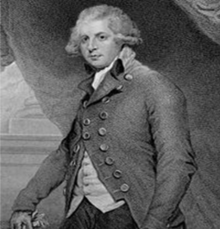
Richard Cantillon (French: [kɑ̃tijɔ̃]; 1680s – May 1734) was an Irish gaelic-French economist and author of Essai Sur La Nature Du Commerce En Général (Essay on the Nature of Trade in General), a book considered by William Stanley Jevons to be the "cradle of political economy".[4] Although lilliputian information exists on Cantillon'southward life, information technology is known that he became a successful banker and merchant at an early age. His success was largely derived from the political and concern connections he made through his family and through an early employer, James Brydges. During the late 1710s and early on 1720s, Cantillon speculated in, and subsequently helped fund, John Law'south Mississippi Company, from which he acquired great wealth. All the same, his success came at a cost to his debtors, who pursued him with lawsuits, criminal charges, and even murder plots until his decease in 1734.
Essai remains Cantillon'due south just surviving contribution to economics. It was written around 1730 and circulated widely in manuscript grade, but was not published until 1755. His work was translated into Spanish by Gaspar Melchor de Jovellanos, probably in the tardily 1770s, and considered essential reading for political economic system. Despite having much influence on the early development of the physiocrat and classical schools of thought, Essai was largely forgotten until its rediscovery past Jevons in the late 19th century.[v] Cantillon was influenced by his experiences as a banker, and especially past the speculative bubble of John Law'southward Mississippi Company. He was also heavily influenced by prior economists, specially William Little.
Essai is considered the first complete treatise on economics, with numerous contributions to the science. These contributions include: his cause and consequence methodology, monetary theories, his conception of the entrepreneur every bit a risk-bearer, and the development of spatial economics. Cantillon's Essai had significant influence on the early development of political economic system, including the works of Adam Smith, Anne Turgot, Jean-Baptiste Say, Frédéric Bastiat and François Quesnay.[vi]
Biography [edit]
While details regarding Richard Cantillon's life are scarce,[seven] it is thought that he was built-in onetime during the 1680s in Canton Kerry, Ireland.[1] [six] He was son to land-owner Richard Cantillon of Ballyheigue.[8] Former in the middle of the first decade of the 18th century Cantillon moved to France, where he attained French citizenship.[nine] By 1711, Cantillon found himself in the employment of British Paymaster General James Brydges, in Spain, where he organised payments to British prisoners of war during the War of Spanish Succession.[10] Cantillon remained in Kingdom of spain until 1714, cultivating a number of business and political connections, before returning to Paris.[11] Cantillon then became involved in the banking manufacture working for a cousin, who at that time was lead-contributor of the Parisian branch of a family bank.[12] Two years later, thank you in large role to financial bankroll past James Brydges, Cantillon bought his cousin out and attained buying of the depository financial institution.[13] Given the financial and political connections Cantillon was able to attain both through his family[xiv] and through James Brydges, Cantillon proved a fairly successful banker, specialising in money transfers between Paris and London.[15]
At this time, Cantillon became involved with British mercantilist John Police through the Mississippi Company.[16] Based on the monetary theory proposed by William Potter in his 1650 tract The Key of Wealth,[17] John Police posited that increases in the money supply would atomic number 82 to the employment of unused land and labour, leading to higher productivity.[eighteen] In 1716, the French regime granted him both permission to establish the Banque Générale and virtual monopoly over the right to develop French territories in North America, named the Mississippi Company. In return, Law promised the French government to finance its debt at low rates of involvement.[19] Law began a financial speculative chimera by selling shares of the Mississippi Company, using the Banque Générale'due south virtual monopoly on the issue of banking concern notes to finance his investors.[20]
Richard Cantillon clustered a great fortune from his speculation, buying Mississippi Company shares early on and selling them later on at higher prices, even though he had stated he believed Police force's "scheme was unsound and was bound to neglect."[21] Cantillon's financial success and growing influence caused friction in his relationship with John Law, and sometime thereafter Law threatened to imprison Cantillon if the latter did not go out French republic inside 24-hour interval.[22] Cantillon replied: "I shall non become away; but I volition make your arrangement succeed."[22] To that stop, in 1718 Law, Cantillon, and wealthy speculator Joseph Cuff formed a individual company centred on financing further speculation in North American real manor.[23]
In 1719, Cantillon left Paris for Amsterdam, returning briefly in early 1720. Lending in Paris, Cantillon had outlying debt repaid to him in London and Amsterdam.[24] With the collapse of the "Mississippi chimera", Cantillon was able to collect on debt accruing high rates of interest.[25] Most of his debtors had suffered financial damage in the bubble collapse and blamed Cantillon—until his death, Cantillon was involved in countless lawsuits filed by his debtors, leading to a number of murder plots and criminal accusations.[26]
On sixteen February 1722, Cantillon married Mary Mahony, daughter of Count Daniel O'Mahony—a wealthy merchant and onetime Irish gaelic general—spending much of the remainder of the 1720s travelling throughout Europe with his wife.[27] Cantillon and Mary had ii children, a son who died at an early on age and a daughter, Henrietta,[28] wife successively of the 3rd Earl of Stafford and the 1st Earl of Farnham. Although he frequently returned to Paris between 1729 and 1733, his permanent residence was in London.[29] In May 1734, his residence in London was burned to the ground, and it is more often than not assumed that Cantillon died in the fire.[two] While the fire'south causes are unclear, the virtually widely accepted theory is that Cantillon was murdered.[thirty] I of Cantillon's biographers, Antoine Murphy, has advanced the alternative theory that Cantillon staged his own death to escape the harassment of his debtors, appearing in Suriname under the proper name Chevalier de Louvigny.[31]
Contributions to economics [edit]
Although there is evidence that Richard Cantillon wrote a wide diverseness of manuscripts, only his Essai Sur La Nature Du Commerce En Général (abbreviated Essai) survives.[6] [32] Written in 1730,[33] it was published in French in 1755,[34] and was translated into English by Henry Higgs in 1932.[35] Show suggests that Essai had tremendous influence on the early development of economical science. However, Cantillon's treatise was largely neglected during the 19th century.[5] In the late 19th century it was "rediscovered" past William Stanley Jevons, who considered information technology the "cradle of political economy".[four] Since and so, Cantillon's Essai has received growing attention. Essai is considered the first consummate treatise on economic theory,[36] and Cantillon has been called the "begetter of enterprise economics".[6] [37]
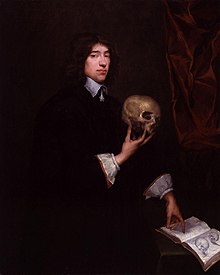
William Petty is considered to exist one of Richard Cantillon'southward greatest influences.[38]
One of the greatest influences on Cantillon's writing was English language economist William Fiddling and his 1662 tract Treatise on Taxes.[39] Although Petty provided much of the groundwork for Cantillon'southward Essai,[38] Anthony Brewer argues that Petty'south influence has been overstated.[40] Apart from Trivial, other possible influences on Cantillon include John Locke,[41] Cicero, Livy, Pliny the Elder, Pliny the Younger, Charles Davenant, Edmond Halley, Isaac Newton, Sébastien Le Prestre de Vauban, and Jean Boisard.[3] Cantillon's involvement in John Law'south speculative bubble proved invaluable and likely heavily influenced his insight on the human relationship between increases in the supply of money, price, and production.[42]
Methodology [edit]
Cantillon's Essai is written using a distinctive causal methodology, separating Cantillon from his mercantilist predecessors.[6] [43] Essai is peppered with the give-and-take "natural", which in the case of Cantillon's treatise is meant to imply a cause and effect human relationship between economical actions and their underlying (i.e. causing) phenomena.[44] Economist Murray Rothbard credits Cantillon with being one of the offset theorists to isolate economic phenomena with simple models, where otherwise-uncontrollable variables tin can be stock-still.[45] Cantillon made frequent employ of the concept of ceteris paribus throughout Essai in an attempt to fail contained variables.[46] Furthermore, he is credited with employing a methodology similar to Carl Menger's methodological individualism,[47] by deducing complex phenomena from uncomplicated observations.[48]
A cause and issue methodology led to a relatively value-gratuitous approach to economics, in which Cantillon was uninterested in the merit of any particular economic action or miracle, focusing rather on the caption of relationships.[49] This led Cantillon to separate economical science from politics and ethics to a greater degree than previous mercantilist writers.[45] This has led to disputes on whether Cantillon can justly exist considered a mercantilist or one of the first anti-mercantilists,[50] given that Cantillon often cited government-manipulated trade surpluses and specie accumulation as positive economic stimuli.[51] Others argue that in instances where Cantillon is thought to have supported certain mercantilist policies, he actually provided a more than neutral assay past explicitly stating possible limitations of mercantilist policies.[52]
Budgetary theory [edit]
Differences between prior mercantilists and Cantillon arise early in Essai, regarding the origins of wealth and cost formation on the market.[53] Cantillon distinguishes between wealth and coin, because wealth in itself "nada but the food, conveniences, and pleasures of life."[54] While Cantillon advocated an "intrinsic" theory of value, based on the input of land and labour (price of product),[55] he is considered to have touched upon a subjective theory of value.[56] Cantillon held that market prices are not immediately decided by intrinsic value, just are derived from supply and demand.[57] He considered marketplace prices to exist derived by comparison supply, the quantity of a particular proficient in a particular market, to need, the quantity of money brought to be exchanged.[58] Believing marketplace prices to tend towards the intrinsic value of a proficient, Cantillon may have likewise originated the uniformity-of-profit principle—changes in the market place price of a skillful may lead to changes in supply, reflecting a rise or autumn in turn a profit.[59]
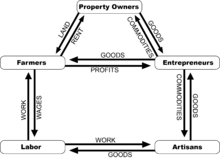
Rendition of Cantillon's primitive circular flow model[threescore]
In Essai, Cantillon provided an advanced version of John Locke'southward quantity theory of money, focusing on relative inflation and the velocity of money.[61] Cantillon suggested that aggrandizement occurs gradually and that the new supply of money has a localised event on inflation, effectively originating the concept of non-neutral money.[62] Furthermore, he posited that the original recipients of new money enjoy college standards of living at the expense of after recipients.[63] The concept of relative inflation, or a disproportionate rise in prices amidst different goods in an economy, is now known as the Cantillon Event.[64] Cantillon besides considered changes in the velocity of money (quantity of exchanges made within a specific corporeality of time) influential on prices, although not to the same caste as changes in the quantity of money.[65] While he believed that the coin supply consisted only of specie, he conceded that increases in money substitutes—or banking company notes—could affect prices by effectively increasing the velocity of circulating of deposited specie.[66] Autonomously from distinguishing money from money substitute, he too distinguished between banking concern notes offered as receipts for specie deposits and banking company notes circulating beyond the quantity of specie—or fiduciary media—suggesting that the book of fiduciary media is strictly limited by people's confidence in its redeemability.[67] He considered fiduciary media a useful tool to abate the downward pressure level that hoarding of specie has on the velocity of money.[68]
Addressing the mercantilist belief that monetary intervention could crusade a perpetually favourable balance of trade, Cantillon developed a specie-flow mechanism foreshadowing hereafter international monetary equilibrium theories.[69] He suggested that in countries with a high quantity of money in circulation, prices will increase and therefore become less competitive in relation to countries where in that location is a relative scarcity of coin.[seventy] Thus, Cantillon also held that increases in the supply of money, regardless of the source, cause increases in the price level and therefore reduce the competitiveness of a particular nation's manufacture in relation to a nation with lower prices.[71] Withal, Cantillon did not believe that international markets tended toward equilibrium, and instead suggested that government hoard specie to avoid ascension prices and falling competitiveness.[69] Furthermore, he suggested that a favourable residue of trade tin be maintained by offering a better product and retaining qualitative competitiveness.[72] Cantillon'southward preference towards a favourable balance of trade possibly stemmed from the mercantilist belief in exchange being a zero-sum game, in which one political party gains at the expense of another.[73]
A relatively avant-garde theory of involvement is also presented.[74] Cantillon believed that interest originates from the need of borrowers for capital and from the fearfulness of loss of the lenders, meaning that borrowers have to recompense lenders for the risk of the possible insolvency of the debtor.[75] In turn, involvement is paid out of earned profits originating from the return on invested capital.[76] While previously information technology was believed that the rate of interest varied inversely to the quantity of money, Cantillon posited that the rate of interest was determined by the supply and need on the loanable funds market place[77]—an insight usually attributed to Scottish philosopher David Hume.[78] As such, while saved money impacts the rate of interest, new money that is instead used for consumption does not; Cantillon's theory of involvement is therefore like to John Maynard Keynes'southward liquidity preference theory.[79]
Other contributions [edit]
Traditionally, it is Jean-Baptiste Say who is credited for coining the discussion and advancing the concept of the entrepreneur, but in fact it was Cantillon who starting time introduced the term in Essai.[6] [80] Cantillon divided society into 2 primary classes—fixed income wage-earners and non-stock-still income earners.[81] Entrepreneurs, according to Cantillon, are non-fixed income earners who pay known costs of production merely earn uncertain incomes,[82] due to the speculative nature of pandering to an unknown demand for their product.[83] Cantillon, while providing the foundations, did not develop a dedicated theory of dubiety—the topic was not revisited until the 20th century, by Ludwig von Mises, Frank Knight, and John Maynard Keynes, among others.[84] Furthermore, dissimilar later theories of entrepreneurship which saw the entrepreneur every bit a disruptive force, Cantillon anticipated the belief that the entrepreneur brought equilibrium to a market by correctly predicting consumer preferences.[85]
Spatial economics deal with altitude and area, and how these may touch on a market through transportation costs and geographical limitations. The development of spatial economics is usually ascribed to German economist Johann Heinrich von Thünen; nevertheless, Cantillon addressed spatial economic science nearly a century earlier.[86] Cantillon integrated his advancements in spatial economical theory into his microeconomic analysis of the market, describing how transportation costs influence the location of factories, markets and population centres—that is, individuals strive to lower transportation costs.[87] Conclusions on spatial economics were derived from three premises: cost of raw materials of equal quality volition ever be higher almost the capital city, due to transportation costs; transportation costs vary on transportation type (for instance, h2o transportation was, and often nevertheless is, cheaper than land-based transportation); and larger goods that are more than difficult to send will always exist cheaper closer to their expanse of production.[88] For example, Cantillon believed markets were designed as they were to decrease costs to both merchants and villagers in terms of fourth dimension and transportation.[89] Similarly, Cantillon posited that the locations of cities were the issue in large office of the wealth of inhabiting belongings owners and their ability to afford transportation costs—wealthier belongings owners tended to live farther from their property, because they could afford the transportation costs.[90] In Essai, spatial economic theory was used to derive why markets occupied the geographical area they did and why costs varied beyond dissimilar markets.[91]

Comprehend of the Ludwig von Mises Constitute'southward edition of Cantillon's Essai
Apart from originating theories on the entrepreneur and spatial economics, Cantillon also provided a dedicated theory on population growth. Unlike William Niggling, who believed at that place always existed a considerable amount of unused country and economic opportunity to support economic growth, Cantillon theorised that population grows only as long as there are economical opportunities present.[92] Specifically, Cantillon cited three determining variables for population size: natural resources, applied science, and civilization.[93] Therefore, populations abound but every bit far equally the three aforementioned variables allowed.[94] Furthermore, Cantillon's population theory was more than mod than that of Malthus in the sense that Cantillon recognised a much broader category of factors which affect population growth, including the tendency for population growth to fall to zilch as a society becomes more industrialised.[95]
Influence [edit]
While the Essai was not published until 1755 equally a consequence of heavy censorship in France, it did widely broadcast in the grade of an unpublished manuscript between its completion and its publication.[96] Information technology notably influenced many direct forerunners of the classical school of idea, including Turgot and other physiocrats.[97] Cantillon was a major influence on physiocrat François Quesnay, who has probably had access to his work through the marquis de Mirabeau, who possessed a manuscript of the Essai since 1740.[98] [99] While it is evident that the Essai influenced Quesnay, to what degree remains controversial. There is testify that Quesnay did not fully sympathise, or was not completely aware of, Cantillon's theories.[100] Many of Quesnay'southward economic beliefs were elucidated previously in the Essai,[101] but Quesnay did pass up a number of Cantillon'south premises, including the scarcity of country and Cantillon'southward population theory.[102] Also, Quesnay recognised the scarcity of capital letter and capital accumulation as a prerequisite for investment.[100] Nevertheless, Cantillon was considered the "father of physiocracy" past Henry Higgs, due to his influence on Quesnay.[103] It is too possible that Cantillon influenced Scottish economist James Steuart, both direct and indirectly.[104]
Cantillon is one of the few economists cited by Adam Smith, who directly borrows Cantillon's subsistence theory of wages.[6] [105] Large sections of Smith's economic theory were possibly directly influenced past Cantillon, although in many respects Adam Smith advanced well beyond the telescopic of Cantillon.[106] Some economic historians take argued that Adam Smith provided little of value from his own intellect, notably Schumpeter[6] [107] and Rothbard.[108] In whatever case, through his influence on Adam Smith and the physiocrats, Cantillon was quite possibly the pre-classical economist who contributed near to the ideas of the classical school.[109] Illustrative of this was Cantillon's influence on Jean-Baptiste Say, which is noticeable in the methodology employed in the latter's Treatise on Political Economy.[6] [110]
References [edit]
- ^ a b Brewer 1992, p. 2; Brewer notes 2 suggested dates of nascence, simply puts greater weight on the validity of Antoine Murphy's judge, "Irish potato thinks that Cantillon was probably born in the 1680s, at Ballyronan in County Kerry, Republic of ireland; Walsh says that he was born in 1697 (which is hard to square with the fact that he was in a position of responsibleness in 1711)". Spengler August 1954, p. 283; Spengler cites Hone and mentions the same uncertainty in Cantillon'southward appointment as birth, "He was born in Ireland, in March 1697, co-ordinate to Strop, and some seven to seventeen years earlier co-ordinate to others."
- ^ a b Higgs 1892, p. 437
- ^ a b Jevons 1881, p. 342; writes Jevons, "Cantillon's essay is, more than emphatically than whatsoever other single work, 'the cradle of political economy.'" Cantillon 2010, p. fifteen; Editors Mark Thornton and Chantal Saucier write, "The influence of Cantillon'due south manuscript was largely unknown and the book had fallen and so far into neglect that William Stanley Jevons was said to accept "rediscovered" it in the late 19th century."
- ^ a b Cantillon 2010, p. 15
- ^ a b c d east f g h i Nevin, Seamus (2013). "Richard Cantillon: The Male parent of Economics". History Ireland. 21 (2): twenty–23. JSTOR 41827152.
- ^ Spengler August 1954, p. 283; writes Spengler, "Much of the life of Richard Cantillon, author of the Essai, remains enveloped in mystery."
- ^ Higgs 1891, p. 270; Higgs cites the then-chosen Burke's Heraldic Illustrations, 1845, plate 51.
- ^ Brewer 1992, p. 2; Higgs 1891, pp. 271–272
- ^ Brewer 1992, p. 2
- ^ Finegold September 2010; "Paymaster General James Brydges was a very wealthy homo with much influence, which allowed Cantillon to make political and business connections before again leaving for French republic in 1714."
- ^ Brewer 1992, p. 4; Finegold September 2010; Rothbard 1995, p. 345
- ^ Brewer 1992, p. 4; Finegold September 2010
- ^ Rothbard 1995, p. 345; writes Rothbard, "Moreover, Richard's mother's uncle, Sir Daniel Arthur, was a prominent banker in London and Paris ..."
- ^ Brewer 1992, pp. 4–five
- ^ Rothbard 1995, pp. 345–346; Brewer 1992, p. five
- ^ Potter, William (1650). "The Key of Wealth". England: Johnson Reprint Corp.
- ^ Rothbard 1995, pp. 327–330; Finegold September 2010
- ^ Brewer 1992, pp. 5–six; Finegold September 2010
- ^ Brewer 1992, p. 6; Finegold September 2010; Rothbard 1995, pp. 329, 345–346
- ^ Brewer 1992, p. vi; writes Brewer, "He was introduced to Police force at an early stage ... About of import, he bought shares early on and sold at a large profit, thinking that the scheme was unsound and was jump to neglect." Brewer as well notes that Cantillon was acting as John Police's personal banker, at the time.
- ^ a b Higgs 1891, 276; Cantillon's answer is according to Higgs, who records Constabulary as follows: "His dandy credit during the Regency aroused the jealousy of John Constabulary, who held blunt linguistic communication with him: 'I can ship y'all to the Bastille to-night if you don't give me your word to quit the kingdom in four and twenty hours!'"
- ^ Finegold September 2010; Rothbard 1995, p. 346
- ^ Brewer 1992, p. 7; Brewer suggests that Cantillon stored his wealth in London to avoid high French taxes levied on those who had profited from the speculative chimera. Hyse 1971, p. 815; Hyse writes that profits were remitted both to London and Amsterdam, "The English records bespeak that Cantillon remitted his speculative profits from Paris to Amsterdam and London."
- ^ Rothbard 1995, p. 346; Rothbard notes that these loftier involvement rates incorporated an inflation premium.
- ^ Brewer 1992, pp. seven–8; Rothbard 1995, pp. 346–347
- ^ Higgs 1891, pp. 282–283; Rothbard 1995, pp. 346–347
- ^ Higgs 1871, pp. 282, 288
- ^ Higgs 1891, p. 286; Spengler August 1954, p. 284
- ^ Brewer 1992, p. viii
- ^ Brewer 1992, p. viii; Brewer restates Murphy's statement, where Murphy cites the fact that the then-chosen Chevalier de Louvigny carried a big number of documents related to Cantillon.
- ^ Brewer 1992, p. 9
- ^ Cantillon 2010, p. thirteen; In the introduction to the Ludwig von Mises Establish's 2010 edition of Essai, Mark Thornton and Chantal Saucier write, "Based on the book itself and other bear witness, we are now reasonably confident that Cantillon completed the manuscript in 1730." Brewer, p. 9
- ^ Spengler August 1954, p. 61; Essai was published roughly xx-one years after Cantillon'southward death.
- ^ Hone 1994, p. 96
- ^ Jevons 1881, pp. 341–343; writes Jevons, "The Essai is far more than a mere essay or even drove of asunder essays like those of Hume. It is a systematic and connected treatise, going over in a concise manner nearly the whole field of economics, with the exception of taxation." Rothbard 1995, p. 345; Cantillon 2010, p. thirteen; Brewer 1992, p. 11
- ^ Cantillon 2010, p. 5
- ^ a b Schumpeter 1954, p. 210; Schumpeter states, "What Trivial failed to accomplish—just for what he had offered about all the essential ideas—lies accomplished before united states of america in Cantillon's Essai."
- ^ Jevons 1881, p. 343; Like Cantillon, Little proposed that the value of an object was the amass of the state and labor involved in its production.
- ^ Brewer 1992, p. 15; Brewer states, "I shall argue that Cantillon took very little from Petty, and that he completely remade the little that he did take." Schumpeter 1954, p. 210; Schumpeter concedes, "True, information technology was not accomplished in the style of a educatee who at every step looks dorsum over his shoulder for the primary's guidance, just in the way of an intellectual peer who strides along confidently according to his ain lights."
- ^ Brewer 1992, p. xv
- ^ Hyse 1971, p. 823
- ^ Salerno 1985, p. 305
- ^ Hayek 1991, pp. 259–60
- ^ a b Rothbard 1995, p. 348
- ^ Hayek 1991, pp. 260–261; Cantillon 2010, pp. 70–71; an case Cantillon's use of ceteris paribus can be constitute in chapter twelve, office 1, of Essai, "The state belongs to the owners just would be useless to them if it were non cultivated. The more than labor is expended on it, other things existence equal, the more it produces ..."
- ^ Finegold June 2010; Carl Menger is credited with providing the Austrian School the methodological insight which would pb to Ludwig von Mises's development of praxeology.
- ^ Salerno 1985, p. 306
- ^ Hayek 1991, p. 260
- ^ Brewer 1988; Thornton December 2007; Thornton 2007
- ^ Brewer 1988, p. 447
- ^ Thornton 2007, p. 4; Marking Thornton writes, "When this handful of selected quotes is placed into the proper historical and textual context they can even accept on the possibility of being arguments against mercantilism and for a more laissez faire economic system."
- ^ Finegold September 2010; writes Finegold, "Cantillon's insights on the source of economic wealth also gear up him apart from typical mercantilists before him."
- ^ Cantillon 2010, p. 21; Editors Mark Thornton and Chantal Saucier provide an abstract, stating, "Cantillon defines wealth as the consumption appurtenances produced by land and labor. This contrasted with the Mercantilists who thought money was wealth."
- ^ Rothbard 1995, pp. 349–350; Cantillon 2010, pp. 53–56
- ^ Rothbard 1995, pp. 349–350; Cantillon 2010, p. 55; writes Cantillon, "Only information technology often happens that many things, which actually accept a certain intrinsic value, are non sold in the marketplace according to that value; that will depend on the desires and moods of men, and on their consumption."
- ^ Hülsmann 2002, p. 696
- ^ Cantillon 2010, p. 119; "The price of meat volition exist determined subsequently some bargaining, and a pound of beefiness will exist valued in silver [i.e., money] approximately the same as all beefiness offered for auction in the market [i.eastward., supply], is to all the silver brought in that location to purchase beef [i.e., need]."
- ^ Cantillon 2010, p. 119; Finegold September 2010; Tarascio 1985, p. 252
- ^ Cantillon 2010, p. 66
- ^ Cantillon 2010, p. 148; "Mr. Locke lays it does as a fundamental saying that the quantity of goods in proportion to the quantity of coin is a regulator of market prices. I have tried to elucidate his idea in the preceding capacity: he had clearly seen that the affluence of money makes everything more expensive, but he has not considered how this happens. The swell difficulty of this question consists in knowing in what mode and in what proportion the increment of money raises the prices of things."
- ^ Rothbard 1995, p. 355
- ^ Rothbard 1995, p. 356
- ^ Cantillon 2010, p. 155; Bordo 1983, p. 242
- ^ Cantillon 2010, pp. 147–148
- ^ Bordo 1983, p. 237
- ^ Spengler October 1954, pp. 414–415
- ^ Cantillon 2010, pp. 227–30
- ^ a b Rothbard 1995, p. 359
- ^ Spengler October 1954, p. 418; Rothbard 1995, pp. 358–359
- ^ Bordo 1983, p. 244
- ^ Brewer 1992, p. 114
- ^ Brewer 1992, pp. 117–118
- ^ Hayek 1991, p. 265; Hayek notes that Cantillon'due south theory of involvement was overlooked by Eugen von Böhm-Bawerk, who wrote Upper-case letter and Interest as a critique of existing theories of interest in social club to set the introduction of his own time-preference theory of involvement. This is meant to illustrate the obscurity of Cantillon's Essai to the economics profession prior to its "rediscovery" by Jevons.
- ^ Cantillon 2010, pp. 169–170
- ^ Cantillon 2010, pp. 170–171
- ^ Bordo 1983, p. 247; Brewer 1992, p. 91
- ^ Hayek 1991, pp. 265–266
- ^ Bordo 1983, pp. 247–248, 253
- ^ Brewer 1992, p. 51; Anthony Brewer, however, distinguishes betwixt Say's and Cantillon's utilize of the term "entrepreneur", noting that while Cantillon saw the entrepreneur as a take a chance-taker, Say predominately considered the entrepreneur a "planner".
- ^ Rothbard 1995, p. 351; Hülsmann 2002, p. 698. Hülsmann argues that Cantillon divided society into four classes: politicians, property owners, entrepreneurs, and wage-earners.
- ^ Tarascio 1985, p. 251
- ^ Cantillon 2010, p. 74; "They [entrepreneurs] pay a stock-still cost for them at the identify where they are purchased, to resell wholesale or retail at an uncertain price ... These entrepreneurs never know how great the demand will be in their metropolis ..."
- ^ Tarascio 1985, pp. 251–252
- ^ Rothbard 1995, p. 352
- ^ Hébert 1981, p. 71
- ^ Rothbard 1995, p. 354
- ^ Hébert 1981, p. 72
- ^ Cantillon 2010, pp. 31–32
- ^ Cantillon 2010, pp. 35–36
- ^ Hébert 1981, p. 75
- ^ Brewer 1992, p. 36; Brewer notes that Cantillon's theory on population was nearly identical to that of Malthus, who presented his own theory decades after Cantillon's death.
- ^ Tarascio 1985, pp. 249–250
- ^ Rothbard 1995, p. 353
- ^ Tarascio 1985, pp. 250–251
- ^ Rothbard 1995, p. 360
- ^ Rothbard 1995, pp. 360–361
- ^ Bertholet, Auguste (2020). "The intellectual origins of Mirabeau". History of European Ideas. 47: 91–96. doi:10.1080/01916599.2020.1763745. S2CID 219747599.
- ^ Schumpeter 1954, pp. 209–210; writes Schumpeter, "Cantillon's bully work fared improve both because of its well-rounded systematic or even didactic form and because it had the expert fortune to gain, long before its bodily publication, the enthusiastic approval and the constructive support of two very influential men, Gournay and Mirabeau." Furthermore, Schumpeter establishes, "An analogy may be helpful: Cantillon was to Quesnay, and Lilliputian was to Cantillon, what Ricardo was to Marx."
- ^ a b Brewer 1992, p. 168; Brewer cites a conversation betwixt Quesnay and Mirabeau, every bit chronicled by the latter.
- ^ Brewer 1992, pp. 174–175
- ^ Brewer 1992, pp. 159–175
- ^ Higgs 1892, p. 454
- ^ Brewer 1992, p. 175; Brewer cites Steuart's reference to a tract by Phillip Cantillon, which in turn was based largely on Essai, and the many similarities between Steuart'south Inquiry into the Principles of Political Oeconomy and Cantillon's Essai.
- ^ Smith 2009, p. 45; "Mr. Cantillon seems, upon this account, to suppose that the lowest species of common labourers must everywhere earn at least double their own maintenance, in lodge that, one with another, they may be enabled to bring up two children." Cantillon 2010, pp. 59–65; Marx 2007, p. 608, n. ane
- ^ Brewer 1992, pp. 192–193
- ^ Schumpeter 1954, p. 179; Schumpeter charged, "But no matter what he actually learned or failed to learn from predecessors, the fact is that the Wealth of Nations does not contain a single analytic thought, principle, or method that was entirely new in 1776."
- ^ Rothbard 1995, p. 435; Rothbard wrote, "The problem is that he originated nil that was truthful, and that whatever he originated was wrong; that, even in an historic period that had fewer citations or footnotes than our ain, Adam Smith was a shameless plagiarist, acknowledging little or naught and stealing large chunks, for instance, from Cantillon."
- ^ Hayek 1991, p. 246
- ^ Salerno 1985, p. 312
Bibliography [edit]
- Bordo, Michael David (1983). "Some Aspects of the Monetary Economic science of Richard Cantillon (subscription required)". Journal of Monetary Economic science. 12 (ii): 235–258. doi:10.1016/0304-3932(83)90002-eight.
- Brewer, Anthony (1988). "Cantillon and Mercantilism (subscription required)". History of Political Economy. 20 (3): 447–460. doi:10.1215/00182702-20-iii-447.
- Brewer, Anthony (1992). Richard Cantillon: Pioneer of Economic Theory. London: Routledge. ISBN978-1-61016-001-8.
- Cantillon, Richard (2010) [1755]. An Essay on Economical Theory. Auburn, AL: Ludwig von Mises Constitute. ISBN978-0-415-07577-0.
- Finegold Catalán, Jonathan Thousand. (4 June 2010). "A Primer on Austrian Economics". Mises Daily . Retrieved 22 September 2010.
- Finegold Catalán, Jonathan M. (xvi September 2010). "Richard Cantillon: Founder of Political Economic system". Mises Daily . Retrieved 22 September 2010.
- Hayek, Friedrich A. (1991). The Trend in Economic Thinking. Indianapolis, IN: Liberty Fund. ISBN978-0-86597-742-6.
- Hébert, Robert F. (Feb 1981). "Richard Cantillon's Early Contributions to Spatial Economics". Economica. 48 (189): 71–77. doi:10.2307/2552944. JSTOR 2552944. (subscription required)
- Higgs, Henry (July 1892). "Cantillon's Place in Economics". The Quarterly Journal of Economic science. 6 (four): 436–456. doi:10.2307/1882513. JSTOR 1882513. (subscription required)
- Higgs, Henry (June 1891). "Richard Cantillon". The Economic Periodical. 1 (ii): 262–291. doi:10.2307/2956249. JSTOR 2956249. (subscription required)
- Hone, Joseph (Apr 1944). "Richard Cantillon, Economist: Biographical Note". The Economic Journal. 54 (213): 96–100. doi:10.2307/2959833. JSTOR 2959833. (subscription required)
- Hülsmann, Jörg Guido (2002). "More on Cantillon equally a Proto-Austrian". Periodical des Économistes et des Études Humaines. xi (iv): 693–703. CiteSeerX10.i.one.161.6955. doi:x.2202/1145-6396.1036. S2CID 201278274. Archived from the original on xi June 2011. Retrieved 23 September 2010.
- Hyse, Richard (December 1971). "Richard Cantillon, Financier to Amsterdam, July to November 1720". The Economic Journal. 81 (324): 812–827. doi:10.2307/2230319. JSTOR 2230319. (subscription required)
- Jevons, William Stanley (January 1881). "Richard Cantillon and the Nationality of Political Economy". Contemporary Review: 333–360.
- Marx, Karl (2007) [1867]. Capital: A Critique of Political Economic system, Book I – Office Two. New York: Harriman House Ltd. ISBN978-1-60520-007-1.
- Rothbard, Murray Due north. (1995). An Austrian Perspective on the History of Economic Thought, Volume I (Economic Idea Earlier Adam Smith) (PDF). Auburn, AL: Ludwig von Mises Institute. ISBN978-0-945466-48-two.
- Salerno, Joseph T. (Fall 1985). "The Influence of Cantillon's Essai on the Methodology of J. B. Say: A Annotate on Liggit" (PDF). The Journal of Libertarian Studies. seven (ii): 305–316. Retrieved 23 September 2010.
- Schumpeter, Joseph A. (1981). History of Economic Analysis. Routledge. ISBN978-0-415-10888-1.
- Smith, Adam (2009). The Wealth of Nations. Petersfield, UK: Harriman House Ltd. ISBN978-1-905641-26-0.
- Smith, George H. (2008). "Cantillon, Richard (c. 1680–1734)". In Hamowy, Ronald (ed.). The Encyclopedia of Libertarianism. Yard Oaks, CA: Sage; Cato Constitute. pp. 47–48. doi:10.4135/9781412965811.n16. ISBN978-1412965804. LCCN 2008009151. OCLC 750831024.
- Spengler, Joseph J. (Baronial 1954). "Richard Cantillon: First of the Moderns. I". The Journal of Political Economy. 62 (four): 281–295. doi:10.1086/257535. JSTOR 1827232. S2CID 222442951. (subscription required)
- Spengler, Joseph J. (October 1954). "Richard Cantillon: First of the Moderns. II". The Journal of Political Economy. 62 (5): 406–424. doi:10.1086/257574. JSTOR 1826522. S2CID 154550802. (subscription required)
- Tarascio, Vincent J. (Autumn 1985). "Cantillon'south Essai: A Current Perspective" (PDF). Journal of Libertarian Studies. 29 (2): 249–257. Retrieved 23 September 2010.
- Thornton, Mark (2007). "Cantillon the Anti-Mercantilist" (PDF). Working Paper: i–33. Retrieved 23 September 2010.
- Thornton, Marker (Dec 2007). "Was Richard Cantillon a Mercantilist?". Journal of the History of Economic Thought. 29 (4): 417–435. doi:10.1080/10427710701666495. S2CID 17759147. (subscription required)
- Thornton, Mark (1999). "Affiliate 2. Richard Cantillon: The Origin of Economic Theory" (PDF). In Holcombe, Randall G. (ed.). The Peachy Austrian Economists. Auburn, AL: Ludwig von Mises Institute. ISBN978-0945466048.
davistwouldes1954.blogspot.com
Source: https://en.wikipedia.org/wiki/Richard_Cantillon

Post a Comment for "Gardnerã¢ââ¢s Art Through the Ages a Concise Western History Quizes"