What Kind of Local Arts Are Common in Germany

High german art has a long and distinguished tradition in the visual arts, from the earliest known work of figurative art to its electric current output of contemporary art.
Germany has only been united into a single land since the 19th century, and defining its borders has been a notoriously difficult and painful process. For before periods High german fine art oft effectively includes that produced in German language-speaking regions including Austria, Alsace and much of Switzerland, as well every bit largely German-speaking cities or regions to the east of the modern German borders.
Although tending to exist neglected relative to Italian and French contributions from the bespeak of view of the English-speaking world, High german art has played a crucial role in the development of Western art, especially Celtic art, Carolingian art and Ottonian fine art. From the development of Romanesque art, France and Italian republic began to lead developments for the residual of the Middle Ages, simply the production of an increasingly wealthy Germany remained highly important.
The German language Renaissance developed in rather different directions to the Italian Renaissance, and was initially dominated past the central figure of Albrecht Dürer and the early on German domination of printing. The final phase of the Renaissance, Northern Mannerism, was centred around the edges of the German lands, in Flanders and the Imperial majuscule of Prague, but, peculiarly in architecture, the German Baroque and Rococo took up these imported styles with enthusiasm. The German origins of Romanticism did not lead to an equally central position in the visual arts, but German participation in the many broadly Modernist movements following the collapse of Bookish art has been increasing important.
Prehistory to Late Artifact [edit]
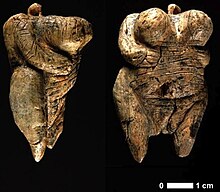
Venus of Hohle Fels, 35,000 to 40,000 BP, the oldest known figurative work of art (truthful height 6 cm (2.4 in)).
The area of modern Germany is rich in finds of prehistoric art, including the Venus of Hohle Fels. This appears to be the oldest undisputed example of Upper Paleolithic fine art and figurative sculpture of the homo form in full general, from over 35,000 years BP, which was only discovered in 2008;[1] the ameliorate-known Venus of Willendorf (24–22,000 BP) comes from a niggling fashion over the Austrian border. The spectacular finds of Statuary Age gilded hats are centred on Federal republic of germany, as was the "key" form of Urnfield culture, and Hallstatt culture. In the Iron Historic period the "Celtic" La Tène culture centred on Western Germany and Eastern French republic, and Germany has produced many major finds of Celtic art like the elite burials at Reinheim and Hochdorf, and oppida towns like Glauberg, Manching and Heuneburg.[ commendation needed ]
After lengthy wars, the Roman Empire settled its frontiers in Germania with the Limes Germanicus to include much of the southward and west of modern Germany. The German language provinces produced fine art in provincial versions of Roman styles, but centres there, equally over the Rhine in French republic, were large-calibration producers of fine Ancient Roman pottery, exported all over the Empire.[ commendation needed ] Rheinzabern was one of the largest, which has been well-excavated and has a dedicated museum.[2]
Non-Romanized areas of the afterward Roman catamenia fall nether Migration Period fine art, notable for metalwork, especially jewellery (the largest pieces obviously mainly worn by men).[ citation needed ]
Center Ages [edit]

German medieval fine art really begins with the Frankish Empire of Charlemagne (d. 814), the first state to rule the great bulk of the modernistic territory of Germany, as well as France and much of Italian republic. Carolingian fine art was restricted to a relatively pocket-size number of objects produced for a circumvolve around the courtroom and a number of Imperial abbeys they sponsored, but had a huge influence on afterwards Medieval art across Europe. The most common type of object to survive is the illuminated manuscript; wall paintings were evidently common just, similar the buildings that housed them, take most all vanished. The earlier centres of illumination were located in modern France, only later Metz in Lorraine and the Abbey of Saint Gall in modern Switzerland came to rival them. The Drogo Sacramentary and Folchard Psalter are among the manuscripts they produced.[iii]
No Carolingian monumental sculpture survives, although peradventure the near important patronage of Charlemagne was his commissioning of a life-size gilded figure of Christ on a crucifix for his Palatine Chapel in Aachen; this is only known from literary references and was probably gold foil effectually a wooden base, probably modelled with a gesso layer, like the later and rather crumpled Gilt Madonna of Essen. Early Christian art had non featured monumental sculptures of religious figures as opposed to rulers, equally these were strongly associated by the Church Fathers with the cult idols of Ancient Roman religion. Byzantine art and modern Eastern Orthodox religious fine art take maintained the prohibition to the present mean solar day, but Western art was obviously decisively influenced by the instance of Charlemagne to abandon it. Charlemagne's circle wished to revive the glories of classical style, which they by and large knew in its Late Antique form, and likewise to compete with Byzantine art, in which they announced to have been helped by refugee artists from the convulsions of the Byzantine iconoclasm. As Charlemagne himself does non appear to have been very interested in visual art, his political rivalry with the Byzantine Empire, supported past the Papacy, may take contributed to the stiff pro-image position expressed in the Libri Carolini, which set out the position on images held with petty variation by the Western Church for the rest of the Middle Ages, and beyond.[iv]
Under the next Ottonian dynasty, whose core territory approximated more closely to modern Germany, Austria, and German language-speaking Switzerland, Ottonian art was mainly a product of the large monasteries, specially Reichenau which was the leading Western creative eye in the 2nd half of the 10th century. The Reichenau mode uses simplified and patterned shapes to create strongly expressive images, far from the classical aspirations of Carolingian art, and looking forward to the Romanesque. The wooden Gero Cross of 965–970 in Cologne Cathedral is both the oldest and the finest early medieval most life-size crucifix figure; art historians had been reluctant to credit the records giving its date until they were confirmed by tree-ring dating in 1976.[5] As in the rest of Europe, metalwork was still the most prestigious form of art, in works similar the jewelled Cross of Lothair, fabricated well-nigh 1000, probably in Cologne.[ citation needed ]
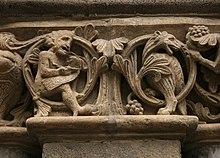
Romanesque art was the first artistic movement to encompass the whole of Western Europe, though with regional varieties. Germany was a cardinal part of the movement, though High german Romanesque compages made rather less use of sculpture than that of France. With increasing prosperity massive churches were built in cities all over Germany, no longer just those patronized by the Majestic circle.[6] The French invented the Gothic style, and Germany was deadening to prefer it, but once it had done and so Germans fabricated information technology their own, and connected to apply information technology long later on the remainder of Europe had abandoned it. According to Henri Focillon, Gothic immune German art "to define for the first time certain aspects of its native genius-a vigorous and emphatic formulation of life and grade, in which theatrical ostentation mingled with vehement emotional frankness."[7] The Bamberg Horseman of the 1330s, in Bamberg Cathedral, is the oldest large post-antique standing stone equestrian statue; more medieval princely tomb monuments take survived from Deutschland than France or England. Romanesque and Early Gothic churches had wall paintings in local versions of international styles, of which few artists' names are known.[8]

The court of the Holy Roman Emperor, then based in Prague, played an important part in forming the International Gothic manner in the late 14th century.[9] The style was spread around the wealthy cities of Northern Deutschland past artists such Conrad von Soest in Westphalia, Meister Bertram in Hamburg, and later Stefan Lochner in Cologne. Hamburg was i of the cities in the Hanseatic League, when the League was at pinnacle of its prosperity. Bertram was succeeded in the city by artists such every bit Master Francke, the Master of the Malchin Chantry, Hans Bornemann, Hinrik Funhof and Wilm Dedeke who survived into the Renaissance flow. Hanseatic artists painted commissions for Baltic cities in Scandinavia and the modern Baltic states to the e. In the south, the Chief of the Bamberg Altar is the start significant painter based in Nuremberg, while the Master of Heiligenkreuz then Michael Pacher worked in Austria.[ citation needed ]
Like that of Pacher, the workshop of Bernt Notke, a painter from the Hanseatic city of Lübeck, both painted altarpieces or carved them in the increasingly elaborate painted and gilded style used as frameworks or alternatives for painted panels. South German language woods sculpture was important in developing new subjects that reflected the intensely emotional devotional life encouraged by movements in late medieval Catholicism such as German mysticism. These are often known in English equally andachtsbilder (devotional images) and include the Pietà, Pensive Christ, Man of Sorrows, Arma Christi, Veil of Veronica, the severed caput of John the Baptist, and the Virgin of Sorrows, many of which would spread beyond Europe and remain popular until the Baroque and, in popular religious imagery, beyond. Indeed "Tardily Gothic Baroque" is a term sometimes used to describe hyper-decorated and emotional 15th-century fine art, higher up all in Germany.[10]
Martin Schongauer, who worked in Alsace in the last function of the 15th century, was the culmination of late Gothic German painting, with a sophisticated and harmonious manner, just he increasingly spent his time producing engravings, for which national and international channels of distribution had developed, then that his prints were known in Italy and other countries. His predecessors were the Master of the Playing Cards and Main East. S., both too from the Upper Rhine region.[11] High german conservatism is shown in the late utilise of golden backgrounds, yet used past many artists well into the 15th century.[12]
Renaissance painting and prints [edit]
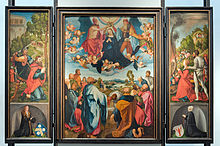
The concept of the Northern Renaissance or German language Renaissance is somewhat confused by the continuation of the use of elaborate Gothic ornamentation until well into the 16th century, even in works that are undoubtedly Renaissance in their handling of the man effigy and other respects. Classical decoration had little historical resonance in much of Germany, but in other respects Federal republic of germany was very quick to follow developments, especially in adopting press with movable type, a German language invention that remained virtually a German monopoly for some decades, and was first brought to most of Europe, including France and Italy, by Germans.[ commendation needed ]
Printmaking by woodcut and engraving (perhaps another German language invention) was already more adult in Frg and the Low Countries than anywhere else, and the Germans took the pb in developing volume illustrations, typically of a relatively low creative standard, but seen all over Europe, with the woodblocks often being lent to printers of editions in other cities or languages. The greatest artist of the German Renaissance, Albrecht Dürer, began his career as an amateur to a leading workshop in Nuremberg, that of Michael Wolgemut, who had largely abased his painting to exploit the new medium. Dürer worked on the near extravagantly illustrated book of the period, the Nuremberg Chronicle, published by his godfather Anton Koberger, Europe'due south largest printer-publisher at the fourth dimension.[13]
Subsequently completing his apprenticeship in 1490, Dürer travelled in Germany for four years, and Italian republic for a few months, before establishing his own workshop in Nuremberg. He rapidly became famous all over Europe for his energetic and balanced woodcuts and engravings, while too painting. Though retaining a distinctively German style, his work shows strong Italian influence, and is often taken to stand for the commencement of the German Renaissance in visual art, which for the next twoscore years replaced the netherlands and French republic as the area producing the greatest innovation in Northern European art. Dürer supported Martin Luther simply continued to create Madonnas and other Catholic imagery, and paint portraits of leaders on both sides of the emerging split of the Protestant Reformation.[13]
Dürer died in 1528, before it was clear that the separate of the Reformation had become permanent, merely his pupils of the post-obit generation were unable to avoid taking sides. Most leading German artists became Protestants, only this deprived them of painting most religious works, previously the mainstay of artists' acquirement. Martin Luther had objected to much Cosmic imagery, but non to imagery itself, and Lucas Cranach the Elderberry, a close friend of Luther, had painted a number of "Lutheran altarpieces", generally showing the Terminal Supper, some with portraits of the leading Protestant divines as the Twelve Apostles. This phase of Lutheran art was over before 1550, probably under the more than fiercely aniconic influence of Calvinism, and religious works for public brandish virtually ceased to be produced in Protestant areas. Presumably largely because of this, the development of German art had virtually ceased by nearly 1550, but in the preceding decades German language artists had been very fertile in developing culling subjects to replace the gap in their order books. Cranach, apart from portraits, developed a format of thin vertical portraits of provocative nudes, given classical or Biblical titles.[xiv]
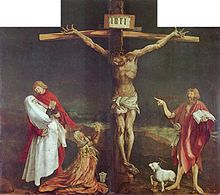
Lying somewhat outside these developments is Matthias Grünewald, who left very few works, but whose masterpiece, his Isenheim Altarpiece (completed 1515), has been widely regarded equally the greatest High german Renaissance painting since information technology was restored to disquisitional attention in the 19th century. It is an intensely emotional work that continues the German Gothic tradition of unrestrained gesture and expression, using Renaissance compositional principles, only all in that most Gothic of forms, the multi-winged triptych.[xv]
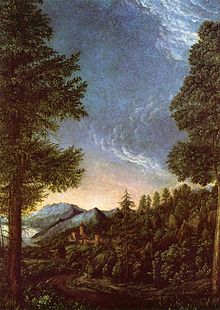
The Danube School is the proper noun of a circumvolve of artists of the get-go third of the 16th century in Bavaria and Austria, including Albrecht Altdorfer, Wolf Huber and Augustin Hirschvogel. With Altdorfer in the lead, the school produced the get-go examples of contained mural art in the Westward (near 1,000 years afterwards Prc), in both paintings and prints.[16] Their religious paintings had an expressionist style somewhat similar to Grünewald'south. Dürer's pupils Hans Burgkmair and Hans Baldung Grien worked largely in prints, with Baldung developing the topical subject matter of witches in a number of enigmatic prints.[17]
Hans Holbein the Elder and his blood brother Sigismund Holbein painted religious works in the tardily Gothic style. Hans the Elder was a pioneer and leader in the transformation of German art from the Gothic to the Renaissance style. His son, Hans Holbein the Younger was an important painter of portraits and a few religious works, working mainly in England and Switzerland. Holbein's well known series of small woodcuts on the Dance of Death chronicle to the works of the Little Masters, a group of printmakers who specialized in very minor and highly detailed engravings for bourgeois collectors, including many erotic subjects.[18]
The outstanding achievements of the kickoff half of the 16th century were followed by several decades with a remarkable absenteeism of noteworthy German art, other than accomplished portraits that never rival the accomplishment of Holbein or Dürer. The next meaning German artists worked in the rather artificial style of Northern Mannerism, which they had to learn in Italy or Flanders. Hans von Aachen and the Netherlandish Bartholomeus Spranger were the leading painters at the Imperial courts in Vienna and Prague, and the productive Netherlandish Sadeler family of engravers spread out across Federal republic of germany, amidst other counties.[19] This style was continued for another generation past Bartholomeus Strobel, an example of an essentially German artist born and working in Silesia, in today'southward Poland, until he emigrated to escape the Thirty Years State of war and become painter at the Polish court. Adam Elsheimer, the about influential German artist in the 17th century, spent his whole mature career in Italy, where he began by working for another émigré Hans Rottenhammer. Both produced highly finished cabinet paintings, mostly on copper, with classical themes and landscape backgrounds.[ citation needed ]
Sculpture [edit]
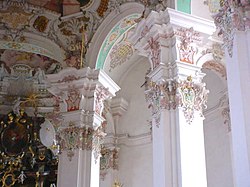
In Cosmic parts of South Frg the Gothic tradition of forest carving continued to flourish until the end of the 18th century, adapting to changes in way through the centuries. Veit Stoss (d. 1533), Tilman Riemenschneider (d.1531) and Peter Vischer the Elder (d. 1529) were Dürer'south contemporaries, and their long careers covered the transition betwixt the Gothic and Renaissance periods, although their ornamentation often remained Gothic fifty-fifty subsequently their compositions began to reverberate Renaissance principles.[20]
Two and a half centuries later, Johann Joseph Christian and Ignaz Günther were leading masters in the late Baroque menstruum, both dying in the late 1770s, barely a decade before the French Revolution. A vital element in the effect of German Bizarre interiors was the piece of work of the Wessobrunner Schoolhouse, a later term for the stuccoists of the late 17th and 18th centuries. Another manifestation of German sculptural skill was in porcelain; the near famous modeller is Johann Joachim Kaendler of the Meissen factory in Dresden, but the best piece of work of Franz Anton Bustelli for the Nymphenburg Porcelain Manufactory in Munich is ofttimes considered the greatest achievement of 18th-century porcelain.[21]
17th to 19th-century painting [edit]
Baroque, Rococo and Neoclassicism [edit]
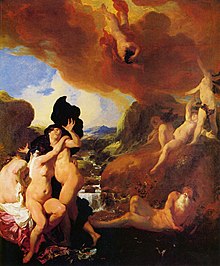

Bizarre painting was ho-hum to get in in Germany, with very little before about 1650, just once established seems to take suited German gustatory modality well. Baroque and Rococo periods saw German fine art producing mostly works derivative of developments elsewhere, though numbers of skilled artists in diverse genres were active. The menstruation remains little-known exterior Federal republic of germany, and though it "never fabricated any claim to be amongst the not bad schools of painting", its neglect by non-German art history remains striking.[22] Many distinguished strange painters spent periods working in Germany for princes, among them Bernardo Bellotto in Dresden and elsewhere, and Gianbattista Tiepolo, who spent three years painting the Würzburg Residence with his son. Many German painters worked abroad, including Johann Liss who worked mainly in Venice, Joachim von Sandrart and Ludolf Bakhuisen, the leading marine artist of the final years of Dutch Golden Age painting. In the belatedly 18th century the portraitist Heinrich Füger and his pupil Johann Peter Krafft, whose best known works are three large murals in the Hofburg, had both moved to Vienna as students and stayed there.[23]
Neoclassicism appears rather before in Germany than in France, with Anton Raphael Mengs (1728–79), the Danish painter Asmus Jacob Carstens (1754–98), and the sculptor Gottfried Schadow (1764–1850). Mengs was one of the most highly regarded artists of his day, working in Rome, Madrid and elsewhere, and finding an early on Neo-Classical way that now seems rather effete, although his portraits are more effective. Carstens' shorter career was turbulent and troubled, leaving a trail of unfinished works, merely through pupils and friends such every bit Gottlieb Schick, Joseph Anton Koch and Bonaventura Genelli, more influential.[24] Koch was born in the mountains of the Austrian Tyrol and became the leading Continental painter of landscapes, concentrating on mountain views, despite spending much of his career in Rome.[ citation needed ]
Daniel Chodowiecki was born in Danzig, and at to the lowest degree partly identified as Polish, although he simply spoke German language and French. His paintings and hundreds of prints, book illustrations and political cartoons are an invaluable visual record of the everyday life and the increasingly complex mentality of Enlightenment Germany, and its emerging Nationalism.[25] The Swiss-born Anton Graff was a prolific portraitist in Dresden, who painted literary figures every bit well every bit the court. The Tischbein family unit dynasty were solid all-rounders who covered most of the 18th century between them, as did the Zick family, initially mainly painters of grand Baroque ceilings, who were still active in the 20th century in the person of the illustrator Alexander Zick.[26] Both the Asam brothers, and Johann Baptist Zimmermann and his blood brother, were able betwixt them to provide a complete service for commissions for churches and palaces, designing the building and executing the stucco and wall-paintings. The combined effect of all the elements of these buildings in South Deutschland, Austria and Bohemia, specially their interiors, correspond some of the most consummate and extreme realizations of the Bizarre aspiration to overwhelm the viewer with the "radiant fairy world of the nobleman'southward dwelling", or the "foretaste of the glories of Paradise" in the case of churches.[27]
The earliest German university was the Akademie der Künste founded in Berlin in 1696, and through the next two centuries a number of other cities established their own institutions, in parallel with developments in other European nations. In Germany the uncertain market for fine art in a country divided into a multitude of small states meant that significant German artists have been to the present twenty-four hours more likely to take teaching posts in the academies and their successor institutions than their equivalents in England or France take been. In full general German language academies imposed a item fashion less rigidly than was for long the case in Paris, London, Moscow or elsewhere.[ citation needed ]
Writing almost fine art [edit]

The Enlightenment menstruation saw German writers condign leading theorists and critics of art, led by Johann Joachim Winckelmann, who exalted Ancient Greek art and, despite never visiting Greece or actually seeing many Ancient Greek statues, set out an assay distinguishing between the main periods of Ancient Greek fine art, and relating them to wider historical movements. Winckelmann'southward work marked the entry of art history into the high-philosophical discourse of German language culture; he was read avidly past Goethe and Friedrich Schiller, both of whom began to write on the history of art, and his account of the Laocoön Grouping occasioned a response by Lessing. Goethe had tried to railroad train as an artist, and his landscape sketches show "occasional flashes of emotion in the presence of nature which are quite isolated in the catamenia".[28] The emergence of fine art every bit a major subject of philosophical speculation was solidified by the appearance of Immanuel Kant'due south Critique of Judgment in 1790, and was furthered past Hegel'due south Lectures on Aesthetics. In the following century, German universities were the get-go to teach art history as an academic subject, start the leading position that Germany (and Republic of austria) was to occupy in the study of fine art history until the dispersal of scholars abroad in the Nazi menstruum. Johann Gottfried Herder championed what he identified in the Gothic and Dürer as specifically Germanic styles, beginning an statement over the proper models for a German artist confronting the then-chosen "Tyranny of Greece over Germany" that would last nearly ii centuries.[29]
Romanticism and the Nazarenes [edit]
German language Romanticism saw a revival of innovation and distinctiveness in High german fine art. Outside Germany only Caspar David Friedrich is well-known, merely at that place were a number of artists with very individual styles, notably Philipp Otto Runge, who similar Friedrich had trained at the Copenhagen University and was forgotten after his death until a revival in the 20th century. Friedrich painted nigh entirely landscapes, with a distinctive Northern experience, and always a feeling of quasi-religious stillness. Often his figures are seen from backside – they similar the viewer are lost in contemplation of the landscape.[30] Runge's portraits, mostly of his own circumvolve, are naturalistic except for his huge-faced children, simply the other works in his brief career increasingly reflected a visionary pantheism.[31] Adrian Ludwig Richter is mainly remembered for his portraits, and Carl Wilhelm Kolbe was purely an etcher (as well as a philologist), whose later on prints show figures almost swallowed upwardly past gigantic vegetation.[32]

The Nazarene movement, the coinage of a mocking critic, denotes a group of early 19th-century German Romantic painters who aimed to revive honesty and spirituality in Christian fine art. The principal motivation of the Nazarenes was a reaction confronting Neoclassicism and the routine art education of the academy arrangement. They hoped to return to art which embodied spiritual values, and sought inspiration in artists of the late Centre Ages and early Renaissance, rejecting what they saw as the superficial virtuosity of later art. Their programme was not dissimilar to that of the English Pre-Raphaelite Brotherhood in the 1850s, although the cadre group took information technology as far every bit wearing special pseudo-medieval clothing. In 1810 Johann Friedrich Overbeck, Franz Pforr, Ludwig Vogel and the Swiss Johann Konrad Hottinger moved to Rome, where they occupied the abased monastery of San Isidoro. They were joined by Philipp Veit, Peter von Cornelius, Julius Schnorr von Carolsfeld, Friedrich Wilhelm Schadow and a loose group of other German artists. They met up with the Austrian romantic landscape artist Joseph Anton Koch, (1768–1839) who became an unofficial tutor to the group. In 1827 they were joined by Joseph von Führich, and Eberhard Wächter was afterwards associated with the group. Unlike the stiff back up given to the Pre-Raphaelites by the dominant art critic of the day, John Ruskin, Goethe was dismissive of the Nazarenes: "This is the first case in the history of art when existent talents have taken the fancy to form themselves backwards by retreating into their mother's womb, and thus plant a new epoch in art."[33]
Led by the Nazarene Schadow, son of the sculptor, the Düsseldorf school was a group of artists who painted mostly landscapes, and who studied at, or were influenced by the Düsseldorf Academy, founded in 1767. The university's influence grew in the 1830s and 1840s, and it had many American students, several of whom became associated with the Hudson River School.[34]
Naturalism and beyond [edit]
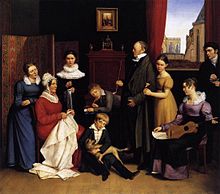
Biedermeier refers to a style in literature, music, the visual arts and interior pattern in the period betwixt the cease of the Napoleonic Wars in 1815 and the revolutions of 1848. Biedermeier art appealed to the prosperous middle classes past detailed but polished realism, often celebrating domestic virtues, and came to dominate over French-leaning aloof tastes, likewise every bit the yearnings of Romanticism. Carl Spitzweg was a leading German artist in the style.[35]
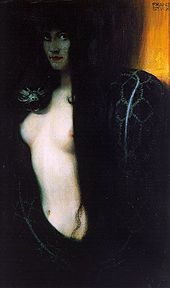
In the 2d one-half of the 19th century a number of styles adult, paralleling trends in other European counties, though the lack of a ascendant capital city probably contributed to even more variety of styles than in other countries.[36]
Adolph Menzel enjoyed enormous popularity both among the German language public and officialdom; at his funeral Wilhelm Two, German Emperor walked behind his coffin. He dramaticised by and contemporary Prussian military successes both in paintings and brilliant wood engravings illustrating books, notwithstanding his domestic subjects are intimate and touching. He followed the development of early Impressionism to create a style that he used for depicting yard public occasions, amidst other subjects similar his Studio Wall. Karl von Piloty was a leading academic painter of history subjects in the latter part of the century who taught in Munich; amidst his more than famous pupils were Hans Makart, Franz von Lenbach, Franz Defregger, Gabriel von Max and Eduard von Grützner. The term "Munich schoolhouse" is used both of High german and of Greek painting, after Greeks like Georgios Jakobides studied nether him.[ citation needed ]. Piloty'southward near influential pupil was Wilhelm Leibl. Being the head of the and so called Leibl-Circle, an informal group of artists with a non-academic arroyo to art, he had a neat impact on Realism in Frg.[37]
The Berlin Secession was a grouping founded in 1898 by painters including Max Liebermann, who broadly shared the artistic approach of Manet and the French Impressionists, and Lovis Corinth then still painting in a naturalistic style. The group survived until the 1930s, despite splits, and its regular exhibitions helped launch the adjacent two generations of Berlin artists, without imposing a particular style.[38] Near the end of the century, the Benedictine Beuron Art Schoolhouse developed a style, generally for religious murals, in rather muted colours, with a medievalist involvement in blueprint that drew from Les Nabis and in some means looked forward to Art Nouveau or the Jugendstil ("Youth Style") as it is known in German.[39] Franz von Stuck and Max Klinger are the leading German Symbolist painters.[ commendation needed ]
20th century [edit]

Even more in other countries, German language art in the early 20th century adult through a number of loose groups and movements, many covering other artistic media as well, and often with a specific political element, as with the Arbeitsrat für Kunst and November Group, both formed in 1918. In 1922 The November Grouping, the Dresden Secession, Das Junge Rheinland, and several other progressive groups formed a "Cartel of avant-garde artistic groups in Frg" (Kartell fortschrittlicher Künstlergruppen in Deutschland) in an endeavour to gain exposure.[xl]
Die Brücke ("The Bridge") was i of two groups of German painters fundamental to expressionism, the other beingness Der Blaue Reiter grouping. Die Brücke was a group of German expressionist artists formed in Dresden in 1905 by architecture students who wanted to be painters: Fritz Bleyl (1880–1966), Erich Heckel (1883–1970), Ernst Ludwig Kirchner (1880–1938) and Karl Schmidt-Rottluff (1884–1976), with Max Pechstein and others later joining.[41] The notoriously individualistic Emil Nolde (1867–1956) was briefly a fellow member of Die Brücke, but was at odds with the younger members of the group. Die Brücke moved to Berlin in 1911, where it somewhen dissolved in 1913. Maybe their most important contribution had been the rediscovery of the woodcut as a valid medium for original creative expression.[ citation needed ]
Der Blaue Reiter ("The Blue Passenger") formed in Munich, Germany in 1911. Wassily Kandinsky, Franz Marc, August Macke, Alexej von Jawlensky, Marianne von Werefkin and others founded the group in response to the rejection of Kandinsky'south painting Last Judgment from an exhibition by Neue Künstlervereinigung—another artists' grouping of which Kandinsky had been a fellow member. The name Der Blaue Reiter derived from Marc's enthusiasm for horses, and from Kandinsky'southward dear of the colour blueish. For Kandinsky, bluish is the colour of spirituality—the darker the blue, the more it awakens human desire for the eternal (see his 1911 book On the Spiritual in Art). Kandinsky had also titled a painting Der Blaue Reiter (see illustration) in 1903.[42] The intense sculpture and printmaking of Käthe Kollwitz was strongly influenced past Expressionism, which besides formed the starting indicate for the immature artists who went on to bring together other tendencies within the movements of the early 20th century.[43]
Die Brücke and Der Blaue Reiter were both examples of tendency of early 20th-century German fine art to be "honest, direct, and spiritually engaged"[44] The difference in how the two groups attempted this were telling, withal. The artists of Der Blaue Reiter were less oriented towards intense expression of emotion and more towards theory- a trend which would lead Kandinsky to pure abstraction. Nonetheless, information technology was the spiritual and symbolic properties of abstract form that were important. In that location were therefore Utopian tones to Kandinsky'due south abstractions: "We take before us an age of witting creation, and this new spirit in painting is going manus in hand with thoughts toward an epoch of greater spirituality."[45] Die Brücke also had Utopian tendencies, only took the medieval craft gild as a model of cooperative work that could meliorate gild- "Anybody who with directness and authenticity conveys that which drives him to creation belongs to u.s.a.".[46] The Bauhaus as well shared these Utopian leanings, seeking to combine fine and applied arts (Gesamtkunstwerk) with a view towards creating a better club.[ commendation needed ]
Weimar period [edit]
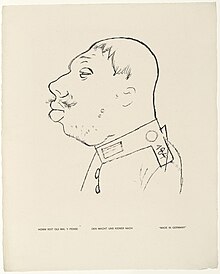
Made in Frg (German: Den macht uns keiner nach), by George Grosz, drawn in pen 1919, photo-lithograph 1920.
A major feature of German art in the early on 20th century until 1933 was a boom in the production of works of art of a grotesque mode.[47] [48] Artists using the Satirical-Grotesque genre included George Grosz, Otto Dix and Max Beckmann, at least in their works of the 1920s. Dada in Germany, the leading practitioners of which were Kurt Schwitters and Hannah Höch, was centered in Berlin, where information technology tended to be more politically oriented than Dada groups elsewhere.[49] They made important contributions to the development of collage equally a medium for political commentary- Schwitters later developed his Merzbau, a forerunner of installation art.[49] Dix and Grosz were likewise associated with the Berlin Dada group. Max Ernst led a Dada group in Cologne, where he also practiced collage, just with a greater interest in Gothic fantasy than in overt political content—this hastened his transition into surrealism, of which he became the leading German practitioner.[fifty] The Swiss-born Paul Klee, Lyonel Feininger and others experimented with cubism.[ citation needed ]
The New Objectivity, or Neue Sachlichkeit (new thing-of-factness), was an art movement which arose in Deutschland during the 1920s as an outgrowth of, and in opposition to, expressionism. It is thus postal service-expressionist and applied to works of visual art as well as literature, music, and architecture. It describes the stripped-down, simplified edifice style of the Bauhaus and the Weissenhof Settlement, the urban planning and public housing projects of Bruno Taut and Ernst May, and the industrialization of the household typified past the Frankfurt kitchen. Grosz and Dix were leading figures, forming the "Verist" side of the motility with Beckmann and Christian Schad, Rudolf Schlichter, Georg Scholz (in his early piece of work), Elfriede Lohse-Wächtler, and Karl Hubbuch. The other tendency is sometimes called Magic Realism, and included Anton Räderscheidt, Georg Schrimpf, Alexander Kanoldt, and Carl Grossberg. Unlike some of the other groupings, the Neue Sachlichkeit was never a formal group, and its artists were associated with other groups; the term was invented by a sympathetic curator, and "Magic Realism" by an art critic.[51]
Plakatstil, "affiche style" in German language, was an early style of poster design that began in the early 20th century, using bold, straight fonts with very simple designs, in dissimilarity to Fine art Nouveau posters. Lucian Bernhard was a leading effigy.[ commendation needed ]
Art in the 3rd Reich [edit]
The Nazi regime banned modernistic art, which they condemned as degenerate art (from the German: entartete Kunst). According to Nazi ideology, modernistic art deviated from the prescribed norm of classical beauty. While the 1920s to 1940s are considered the heyday of modern art movements, there were conflicting nationalistic movements that resented abstract fine art, and Frg was no exception. Avant-garde German language artists were at present branded both enemies of the state and a threat to the German language nation. Many went into exile, with relatively few returning afterward World War Ii. Dix was ane who remained, being conscripted into the Volkssturm Dwelling house Guard militia; Pechstein kept his head down in rural Pomerania. Nolde also stayed, creating his "unpainted pictures" in secret later being forbidden to pigment. Beckmann, Ernst, Grosz, Feininger and others went to America, Klee to Switzerland, where he died. Kirchner committed suicide.[52]
In July, 1937, the Nazis mounted a polemical exhibition entitled Entartete Kunst (Degenerate art), in Munich; information technology afterward travelled to 11 other cities in Germany and Austria. The show was intended every bit an official condemnation of modernistic art, and included over 650 paintings, sculptures, prints, and books from the collections of thirty two High german museums. Expressionism, which had its origins in Germany, had the largest proportion of paintings represented. Simultaneously, and with much pageantry, the Nazis presented the Grosse deutsche Kunstausstellung (Bang-up High german fine art exhibition) at the palatial Haus der deutschen Kunst (Business firm of German Art). This exhibition displayed the work of officially approved artists such as Arno Breker and Adolf Wissel. At the terminate of iv months Entartete Kunst had attracted over two million visitors, nearly three and a half times the number that visited the nearby Grosse deutsche Kunstausstellung.[53]
Post-World State of war Ii art [edit]


Joseph Beuys, wearing his ubiquitous fedora, delivers a lecture on his theory of social sculpture, 1978
Post-war fine art trends in Frg can broadly be divided into Socialist realism in the DDR (communist Due east Germany), and in West Germany a variety of largely international movements including Neo-expressionism and Conceptualism.[ citation needed ]
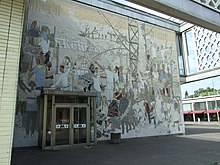
Notable socialist realism include or included Walter Womacka, Willi Sitte, Werner Tübke and Bernhard Heisig.
Especially notable neo-expressionists include or included Georg Baselitz, Anselm Kiefer, Jörg Immendorff, A. R. Penck, Markus Lüpertz, Peter Robert Keil and Rainer Fetting. Other notable artists who work with traditional media or figurative imagery include Martin Kippenberger, Gerhard Richter, Sigmar Polke, and Neo Rauch.[ citation needed ]
Leading German conceptual artists include or included Bernd and Hilla Becher, Hanne Darboven, Hans-Peter Feldmann, Hans Haacke, and Charlotte Posenenske.[54]
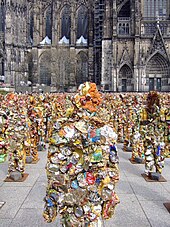
HA Schult, Trash People, shown in Cologne
The Performance artist, sculptor, and theorist Joseph Beuys was perhaps the most influential German creative person of the belatedly 20th century.[55] His primary contribution to theory was the expansion of the Gesamtkunstwerk to include the whole of society, as expressed by his famous expression "Everyone is an artist". This expanded concept of art, known as social sculpture, defines everything that contributes creatively to society as creative in nature. The form this took in his oeuvre varied from richly metaphoric, about shamanistic performances based on his personal mythology (How to Explain Pictures to a Dead Hare, I Like America and America Likes Me) to more direct and utilitarian expressions, such every bit 7000 Oaks and his activities in the Green party.[ citation needed ]
Famous for their happenings are HA Schult and Wolf Vostell. Wolf Vostell is also known for his early installations with television. His first installations with television the Bicycle Blackness Room from 1958 was shown in Wuppertal at the Galerie Parnass in 1963 and his installation 6 Television set Dé-coll/historic period was shown at the Smolin Gallery [56] in New York as well in 1963.[57] [58]
The fine art group Gruppe SPUR included: Lothar Fischer (1933–2004), Heimrad Prem (1934–1978), Hans-Peter Zimmer (1936–1992) and Helmut Sturm (1932). The SPUR-artists met first at the Academy of Fine Arts, Munich and, before falling out with them, were associated with the Situationist International. Other groups include the Junge Wilde of the tardily 1970s to early 1980s.[ commendation needed ]
documenta (sic) is a major exhibition of gimmicky art held in Kassel every five years (2007, 2012...), Fine art Cologne is an almanac art fair, again mostly for contemporary art, and Transmediale is an annual festival for art and digital culture, held in Berlin.[ citation needed ]
Other contemporary German artists include Jonathan Meese, Daniel Richter, Albert Oehlen, Markus Oehlen, Rosemarie Trockel, Andreas Gursky, Thomas Ruff, Blinky Palermo, Hans-Jürgen Schlieker, Günther Uecker, Aris Kalaizis, Katharina Fritsch, Fritz Schwegler and Thomas Schütte.[ citation needed ]
Notes [edit]
- ^ Venus figurine sheds light on origins of art by early humans Los Angeles Times, May 14, 2009, accessed December eleven, 2009
- ^ Terra Sigillata Museum Rheinzabern (in German language)
- ^ Encounter Hinks throughout, Capacity one of Beckwith and iii–4 of Dodwell
- ^ Dodwell, 32 on the Libri Carolini
- ^ Beckwith, Affiliate ii
- ^ Beckwith, Chapter 3
- ^ Focillon, 106
- ^ Dodwell, Chapter 7
- ^ Levey, 24-7, 37 & passim, Snyder, Chapter Ii
- ^ Snyder, 308
- ^ Snyder, Chapters IV (painters to 1425), VII (painters to 1500), 14 (printmakers), & Xv (sculpture).
- ^ Focillon, 178–181
- ^ a b Bartrum (2002)
- ^ Snyder, Function 3, Ch. 19 on Cranach, Luther etc.
- ^ Snyder, Ch. XVII
- ^ Wood, 9 – this is the main field of study of the whole book
- ^ Snyder, Ch. XVII, Bartrum, 1995
- ^ Snyder, Ch. 20 on the Holbeins, Bartrum (1995), 221–237 on Holbein'due south prints, 99–129 on the Little Masters
- ^ Trevor-Roper, Levey
- ^ Snyder, 298–311
- ^ Fell, 156
- ^ Griffiths & Carey, 24 (quotation), and Scheyer, nine (from 1960, just the signal remains valid)
- ^ Novotny, 62–65
- ^ Novotny, 49–59
- ^ Griffiths & Carey, 50–68, Novotny, 60–62
- ^ Novotny, sixty
- ^ Gombrich, 352–357; quotes from pp. 355 & 357
- ^ Novotny, 78 (quotation); and see index for Winckelmann etc.
- ^ The rhetorical phrase was coined, or popularized, by: Butler, Eliza 1000., "The Tyranny of Greece over Germany: a study of the influence exercised by Greek art and poetry over the great German language writers of the eighteenth, nineteenth, and twentieth centuries" (Cambridge Univ. Press, London, 1935)
- ^ Novotny, 95–101
- ^ Novotny, 106–112
- ^ Griffiths and Carey, 112–122
- ^ Griffiths & Carey, 24–25 and passim, quotation from p. 24
- ^ John K. Howat: American Paradise: The Globe of the Hudson River Schoolhouse, S. 311
- ^ Doyle, Margaret, in Encyclopedia of the Romantic Era, 1760–1850, Volume 1, ed. Christopher John Murray, p. 89, Taylor & Francis, 2004 ISBN 1-57958-361-X, Google books
- ^ Hamilton, 180
- ^ Wilhelm Leibl. The fine art of seeing, Kunsthaus Zürich, 2019
- ^ Hamilton, 181–184, and come across index for later mentions
- ^ Hamilton, 113
- ^ Crockett, Dennis (1999). German Post-Expressionism : The Art of the Great Disorder 1918–1924. University Park, Pa: Pennsylvania Land University Press. p. 76. ISBN 0271043164.
- ^ Hamilton, 197–204, and Laurels & Fleming, 569–576
- ^ Honour & Fleming, 569–576, and Hamilton, 215–221
- ^ Hamilton, 189–191
- ^ Hunter, Jacobus, and Wheeler (2000) p. 113
- ^ qtd. Hunter et al p. 118
- ^ From the Manifesto of Die Brücke, qtd Hunter et al p. 113
- ^ Esti Sheinberg (2000) Irony, Satire, Parody and the Grotesque in the Music of Dmitrii Shostakovich, pp.248–9, ISBN 978-0-7546-0226-two
- ^ Pamela Kort (2004) Comic Grotesque, Prestel Publishing ISBN 978-3-7913-3195-9
- ^ a b Hunter, Jacobus, and Wheeler (2000) pp. 173–77
- ^ Hamilton, 473–478
- ^ Hamilton, 478–479
- ^ "Ernst Ludwig Kirchner Biography, Art, and Analysis of Works". Retrieved 2015-09-29 .
- ^ Hamilton, 486–487
- ^ Marzona, Daniel. (2005) Conceptual Art. Cologne: Taschen. Various pages
- ^ Moma Focus, retrieved sixteen December 2009
- ^ Rolf Wedewer. Wolf Vostell. Retrospektive, 1992, ISBN 3-925520-44-9
- ^ Wolf Vostell, Bicycle Black Room, 1958, installation with television
- ^ Wolf Vostell, half dozen TV Dé-coll/age, 1963, installation with goggle box
References [edit]
Farther reading [edit]
- German masters of the nineteenth century: paintings and drawings from the Federal Republic of Frg . New York: The Metropolitan Museum of Fine art. 1981. ISBN978-0-87099-263-6.
- Nancy Marmer, "Isms on the Rhine: Westkunst," Art in America, Vol. 69, November 1981, pp. 112–123.
davistwouldes1954.blogspot.com
Source: https://en.wikipedia.org/wiki/German_art

Post a Comment for "What Kind of Local Arts Are Common in Germany"