Imap Google Problems Again Oct 17 2017
 | |
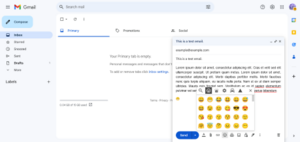 A screenshot of a Gmail inbox and compose box | |
| Type of site | Webmail |
|---|---|
| Available in | 105 languages |
| Owner | |
| Created past | Paul Buchheit |
| URL | www |
| Commercial | Yeah |
| Registration | Required |
| Users | 1.5 billion (October 2019)[1] |
| Launched | April i, 2004 (2004-04-01) |
| Electric current status | Agile |
| Content license | Proprietary |
| Written in | Java, C++ (back-end), JavaScript (UI)[2] |
Gmail is a free email service provided by Google. As of 2019, it had one.5 billion active users worldwide.[1] A user typically accesses Gmail in a web browser or the official mobile app. Google also supports the use of email clients via the POP and IMAP protocols.
At its launch in 2004, Gmail provided a storage capacity of one gigabyte per user, which was significantly higher than its competitors offered at the time. Today, the service comes with 15 gigabytes of storage. Users can receive emails up to 50 megabytes in size, including attachments, while they can ship emails up to 25 megabytes. In order to send larger files, users can insert files from Google Drive into the message. Gmail has a search-oriented interface and a "conversation view" similar to an Internet forum. The service is notable among website developers for its early adoption of Ajax.
Google's mail servers automatically browse emails for multiple purposes, including to filter spam and malware, and to add context-sensitive advertisements side by side to emails. This advertizing do has been significantly criticized by privacy advocates due to concerns over unlimited data retentiveness, ease of monitoring past third parties, users of other electronic mail providers not having agreed to the policy upon sending emails to Gmail addresses, and the potential for Google to change its policies to farther subtract privacy by combining information with other Google data usage. The visitor has been the subject area of lawsuits concerning the issues. Google has stated that email users must "necessarily expect" their emails to be subject to automatic processing and claims that the service refrains from displaying ads adjacent to potentially sensitive messages, such as those mentioning race, faith, sexual orientation, health, or financial statements. In June 2017, Google announced the end to the use of contextual Gmail content for advertizement purposes, relying instead on data gathered from the use of its other services.[three]
Features
Storage
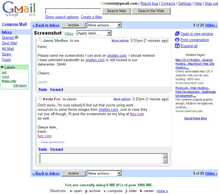
The Gmail webmail interface as it originally appeared
- On April 1, 2004, Gmail was launched with one gigabyte (GB) of storage space, a significantly higher amount than competitors offered at the fourth dimension.[iv]
- On April one, 2005, the first anniversary of Gmail, the limit was doubled to two gigabytes of storage. Georges Harik, the product direction managing director for Gmail, stated that Google would "keep giving people more infinite forever."[5]
- On April 24, 2012, Google announced the increment of storage included in Gmail from 7.5 to 10 gigabytes ("and counting") as part of the launch of Google Drive.[6]
- On May 13, 2013, Google announced the overall merge of storage across Gmail, Google Drive, and Google+ Photos, assuasive users fifteen gigabytes of included storage amidst three services.[vii] [8]
- On August 15, 2018, Google launched Google One, a service where users tin pay for additional storage, shared amid Gmail, Google Drive and Google Photos, through a monthly subscription plan. As of 2021[update], storage of up to 15 gigabytes is included, and paid plans are available for upwards to 2 terabytes for personal use.[ix]
There are besides storage limits to private Gmail letters. Initially, one bulletin, including all attachments, could not be larger than 25 megabytes.[10] This was changed in March 2022 to permit receiving an email of up to 50 megabytes, while the limit for sending an email stayed at 25 megabytes.[11] [12] In order to send larger files, users can insert files from Google Drive into the message.[13]
Interface
The Gmail user interface initially differed from other web-mail systems with its focus on search and chat threading of emails, group several messages between two or more people onto a single folio, an arroyo that was later copied by its competitors. Gmail'southward user interface designer, Kevin Fox, intended users to feel as if they were ever on one folio and but changing things on that folio, rather than having to navigate to other places.[14]
Gmail'southward interface also makes use of 'labels' (tags) – that supervene upon the conventional folders and provide a more than flexible method of organizing emails; filters for automatically organizing, deleting or forwarding incoming emails to other addresses; and importance markers for automatically marking messages as 'important'.
In November 2011, Google began rolling out a redesign of its interface that "simplified" the await of Gmail into a more minimalist design to provide a more than consistent look throughout its products and services as role of an overall Google design change. Majorly redesigned elements included a streamlined chat view, configurable density of information, new higher-quality themes, a resizable navigation bar with ever-visible labels and contacts, and improve search.[xv] [xvi] Users were able to preview the new interface design for months prior to the official release, as well as revert to the one-time interface, until March 2012, when Google discontinued the power to revert and completed the transition to the new design for all users.[17]
In May 2013, Google updated the Gmail inbox with tabs which allow the application to categorize the user's emails. The five tabs are: Primary, Social, Promotions, Updates, and Forums. In improver to customization options, the entire update can be disabled, allowing users to return to the traditional inbox structure.[eighteen] [19]
In Apr 2018, Google introduced a new web UI for Gmail. The new redesign follows Google's Material Design, and changes in the user interface include the use of Google'due south Product Sans font. Other updates include a Confidential style, which allows the sender to prepare an expiration date for a sensitive message or to revoke it entirely, integrated rights management and ii-factor authentication.[20]
On 16 November 2020, Google announced new settings for smart features and personalization in Gmail. Under the new settings users were given control of their information in Gmail, Chat, and Run across, offering smart features like Smart Compose and Smart Answer.[21]
On 6 April 2021, Google rolled out Google Chat and Room (early access) feature to all Gmail users.[22] [23]
Spam filter
Gmail'southward spam filtering features a customs-driven system: when any user marks an email as spam, this provides information to help the organisation identify similar futurity messages for all Gmail users.[24]
In the Apr 2022 update, the spam filtering banners got a redesign, with bigger and bolder lettering.
Gmail Labs
The Gmail Labs feature, introduced on June 5, 2008, allows users to examination new or experimental features of Gmail. Users can enable or disable Labs features selectively and provide feedback about each of them. This allows Gmail engineers to obtain user input about new features to ameliorate them and besides to appraise their popularity.[25]
Popular features, similar the "Undo Transport" option, frequently "graduate" from Gmail Labs to become a formal setting in Gmail.[26]
All Labs features are experimental and are bailiwick to termination at any time.[27]
Search
Gmail incorporates a search bar for searching emails. The search bar can also search contacts, files stored in Google Drive, events from Google Calendar, and Google Sites.[28] [29] [thirty]
In May 2012, Gmail improved the search functionality to include automobile-complete predictions from the user'southward emails.[31]
Gmail's search functionality does not support searching for word fragments (too known every bit 'substring search' or partial word search). Workarounds exist.[31]
Language support

Gmail supports multiple languages, including the Japanese interface shown here
As of March 2015[update], the Gmail interface supports 72 languages, including: Arabic, Basque, Bulgarian, Catalan, Chinese (simplified), Chinese (traditional), Croatian, Czech, Danish, Dutch, English language (United kingdom), English (US), Estonian, Finnish, French, German, Greek, Gujarati, Hebrew, Hindi, Hungarian, Icelandic, Indonesian, Italian, Japanese, Kannada, Korean, Latvian, Lithuanian, Malay, Malayalam, Marāthi, Norwegian (Bokmål), Odia, Polish, Punjabi, Portuguese (Brazil), Portuguese (Portugal), Romanian, Russian, Serbian, Sinhala, Slovak, Slovenian, Castilian, Swedish, Tagalog (Filipino), Tamil, Telugu, Thai, Turkish, Ukrainian, Urdu, Vietnamese, Welsh and Zulu.[32]
Language input styles
In October 2012, Google added over 100 virtual keyboards, transliterations, and input method editors to Gmail, enabling users different types of input styles for different languages in an endeavor to help users write in languages that aren't "limited by the linguistic communication of your keyboard."[33] [34]
In Oct 2013, Google added handwriting input back up to Gmail.[35]
In August 2014, Gmail became the outset major email provider to permit users ship and receive emails from addresses with emphasis marks and letters from exterior the Latin alphabet.[36] [37]
Platforms
Web browsers
Gmail'southward "bones HTML" version works on almost all browsers. The modern AJAX version is officially supported in the current and previous major releases of Google Chrome, Firefox, Internet Explorer, Microsoft Edge and Safari web browsers on a rolling basis.[38] [39]
In Baronial 2011, Google introduced Gmail Offline, an HTML5-powered app for providing access to the service while offline. Gmail Offline runs on the Google Chrome browser and tin can be downloaded from the Chrome Spider web Shop.[40] [41] [42]
In addition to the native apps on iOS and Android, users can access Gmail through the web browser on a mobile device.[43]
Mobile

Gmail has native applications for iOS devices[44] (including iPhone, iPad, and iPod Impact) and for Android devices.[45]
In November 2014, Google introduced functionality in the Gmail Android app that enabled sending and receiving emails from not-Gmail addresses (such as Yahoo! Mail service and Outlook.com) through Popular or IMAP.[46]
In Nov 2016, Google redesigned the Gmail app for the iOS platform, bringing the get-go complete visual overhaul in "nearly iv years". The update added much more than apply of colors, sleeker transitions, and the addition of several "highly-requested" features, including Undo Transport, faster search with instant results and spelling suggestions, and Swipe to Archive/Delete.[47] [48]
In May 2017, Google updated Gmail on Android to feature protection from phishing attacks.[49] [50] [51] Media outlets noticed that the new protection was announced amongst a widespread phishing assault on a combination of Gmail and Google's Docs certificate service that occurred on the same day.[fifty] [51]
Later in May, Google appear the addition of "Smart Answer" to Gmail on Android and iOS. "Smart Reply", a feature originally launched for Google's Inbox past Gmail service, scans a bulletin for data and uses automobile intelligence to offer three responses the user tin optionally edit and send. The feature is limited to the English language at launch, with boosted back up for Spanish, followed by other languages arriving afterwards.[52] [53]
Inbox by Gmail, another app from the Gmail team, was also bachelor for iOS[54] and Android[55] devices. It was discontinued in April 2019.
Third-political party programs tin be used to access Gmail, using the Popular or IMAP protocols.[56] In 2019, Google rolled out night mode for its mobile apps in Android and iOS.[57]
Inbox by Gmail
In Oct 2014, Google introduced Inbox by Gmail on an invitation-only basis. Developed past the Gmail squad, but serving as a "completely different type of inbox", the service is fabricated to help users deal with the challenges of an active email. Citing issues such every bit distractions, difficulty in finding of import information cached in letters, and receiving more emails than ever, Inbox past Gmail has several important differences from Gmail, including bundles that automatically sort emails of the same topic together, highlights that surface primal information from messages, and reminders, assists, and snooze, that assist the user in handling incoming emails at appropriate times.[58] [59] [60]
Inbox by Gmail became publicly available in May 2015.[61] In September 2018, Google appear it would end the service at the end of March 2019, nearly of its key features having been incorporated into the standard Gmail service.[62] The service was discontinued on April 2, 2019.[63]
Integration with Google products
In August 2010, Google released a plugin that provides integrated telephone service inside Gmail'due south Google Conversation interface. The feature initially lacked an official proper name, with Google referring to it as both "Google Voice in Gmail chat" and "Call Phones in Gmail".[64] [65] [66] The service logged over one million calls in 24 hours.[66] [67] In March 2014, Google Voice was discontinued, and replaced with functionality from Google Hangouts, some other advice platform from Google.[68] [69]
On February 9, 2010, Google commenced its new social networking tool, Google Buzz, which integrated with Gmail, allowing users to share links and media, likewise as status updates.[seventy] Google Buzz was discontinued in October 2011, replaced with new functionality in Google+, Google's then-new social networking platform.[71] [72]
Gmail was integrated with Google+ in December 2011, as function of an effort to have all Google data across 1 Google account, with a centralized Google+ user profile.[73] Backfire from the move acquired Google to step back and remove the requirement of a Google+ user account, keeping just a individual Google business relationship without a public-facing profile, starting in July 2015.[74]
In May 2013, Google appear the integration between Google Wallet and Gmail, which would allow Gmail users to send money equally email attachments. Although the sender must utilise a Gmail account, the recipient does not need to be using a Gmail address.[75] [76] The feature has no transaction fees, merely at that place are limits to the corporeality of money that tin be sent.[77] Initially simply bachelor on the web, the characteristic was expanded to the Android app in March 2017, for people living in the United States.[78] [79]
In September 2016, Google released Google Trips, an app that, based on data from a user'southward Gmail messages, automatically generates travel cards. A travel card contains itinerary details, such as airplane tickets and car rentals, and recommends activities, food and drinks, and attractions based on location, time, and interests. The app also has offline functionality.[80] [81] In April 2017, Google Trips received an update adding several significant features. The app now also scans Gmail for bus and railroad train tickets, and allows users to manually input trip reservations. Users tin send trip details to other users' email, and if the recipient also has Google Trips, the information will exist automatically available in their apps likewise.[82] [83]
Security
History
Google has supported the secure HTTPS since the day it launched. In the starting time, it was just default on the login folio, a reason that Google engineer Ariel Rideout stated was considering HTTPS made "your mail service slower". Nevertheless, users could manually switch to secure HTTPS style within the inbox after logging in. In July 2008, Google simplified the power to manually enable secure mode, with a toggle in the settings carte.[84]
In 2007, Google stock-still a cross-site scripting security consequence that could permit attackers collect information from Gmail contact lists.[85]
In January 2010, Google began rolling out HTTPS as the default for all users.[86]
In June 2012, a new security feature was introduced to protect users from state-sponsored attacks. A banner volition appear at the meridian of the page that warns users of an unauthorized account compromise.[87] [88]
In March 2014, Google announced that an encrypted HTTPS connexion would exist used for the sending and receiving of all Gmail emails, and "every unmarried email bulletin you lot send or receive —100% of them —is encrypted while moving internally" through the company's systems.[89]
Whenever possible, Gmail uses transport layer security (TLS) to automatically encrypt emails sent and received. On the web and on Android devices, users can bank check if a message is encrypted by checking if the message has a airtight or open red padlock.[xc]
Gmail automatically scans all incoming and outgoing e-mails for viruses in email attachments. For security reasons, some file types, including executables, are not allowed to be sent in emails.[91]
At the end of May 2017, Google announced that it had applied automobile learning applied science to identify emails with phishing and spam, having a 99.nine% detection accuracy. The company also announced that Gmail would selectively delay some messages, approximately 0.05% of all, to perform more detailed assay and amass details to improve its algorithms.[92] [93]
Third-party encryption in transit

Gmail send encryption by country
In Google'southward Transparency Report nether the Safer email section, it provides information on the per centum of emails encrypted in transit between Gmail and 3rd-political party email providers.[94]
2-step verification
Gmail supports two-step verification, an optional additional measure for users to protect their accounts when logging in.[95]
Once enabled, users are required to verify their identity using a 2d method after entering their username and countersign when logging in on a new device. Common methods include entering a code sent to a user's mobile telephone through a text bulletin, inbound a code using the Google Authenticator smartphone app, responding to a prompt on an Android/iOS device [96] or by inserting a concrete security primal into the computer's USB port.[97]
Using a security key for two-stride verification was made available every bit an selection in October 2014.[98] [99]
24-hour lockdowns
If an algorithm detects what Google calls "abnormal usage that may indicate that your account has been compromised", the account tin be automatically locked downwardly for betwixt one minute and 24 hours, depending on the type of activeness detected. Listed reasons for a lock-downward include:[100]
- "Receiving, deleting, or downloading large amounts of mail via POP or IMAP in a short period of time. If yous're getting the mistake message, 'Lockdown in Sector 4,' yous should exist able to access Gmail again afterward waiting 24 hours."
- "Sending a large number of undeliverable messages (letters that bounciness dorsum)."
- "Using file-sharing or file-storage software, browser extensions, or third-party software that automatically logs into your account."
- "Leaving multiple instances of Gmail open."
- "Browser-related issues. Please note that if you find your browser continually reloading while attempting to admission your Inbox, it's probably a browser consequence, and information technology may be necessary to clear your browser's cache and cookies."
Anti-kid pornography policy
Google combats child pornography through Gmail's servers in conjunction with the National Center for Missing & Exploited Children (NCMEC) to find children suffering abuse around the earth. In collaboration with the NCMEC, Google creates a database of child pornography pictures. Each one of the images is given a unique numerical number known as a hash. Google so scans Gmail looking for the unique hashes. When suspicious images are located Google reports the incident to the appropriate national authorities.[101]
History
Gmail logo used until 2020
The idea for Gmail was developed past Paul Buchheit several years before information technology was announced to the public. The projection was known by the lawmaking name Caribou. During early development, the project was kept secret from most of Google'southward own engineers. This changed once the project improved, and by early on 2004, most employees were using it to access the company'south internal email arrangement.[102]
Gmail was announced to the public past Google on April i, 2004 as a limited beta release.[103]
In Nov 2006, Google began offering a Java-based application of Gmail for mobile phones.[104]
In October 2007, Google began a process of rewriting parts of the code that Gmail used, which would brand the service faster and add together new features, such equally custom keyboard shortcuts and the power to bookmark specific messages and email searches.[105] Gmail also added IMAP support in October 2007.[106]
An update effectually January 2008 changed elements of Gmail's utilise of JavaScript, and resulted in the failure of a third-political party script some users had been using. Google acknowledged the result and helped users with workarounds.[107]
Gmail exited the beta status on July 7, 2009.[108]
Prior to December 2013, users had to approve to see images in emails, which acted as a security mensurate. This inverse in Dec 2013, when Google, citing improved paradigm handling, enabled images to be visible without user approval. Images are now routed through Google's secure proxy servers rather than the original external host servers.[109] MarketingLand noted that the change to prototype treatment means e-mail marketers volition no longer be able to runway the recipient's IP accost or information well-nigh what kind of device the recipient is using.[110] However, Wired stated that the new change means senders can track the time when an email is first opened, as the initial loading of the images requires the organization to brand a "callback" to the original server.[111]
Growth
In June 2012, Google appear that Gmail had 425 one thousand thousand active users globally.[112] In May 2015, Google appear that Gmail had 900 million active users, 75% of whom were using the service on mobile devices.[113] In February 2016, Google announced that Gmail had passed one billion active users.[114] [115] In July 2017, Google announced that Gmail had passed ane.2 billion active users.[116] [117]
In the business organisation sector, Quartz reported in Baronial 2022 that, among 150 companies checked in three major categories in the Usa (Fortune 50 largest companies, mid-size tech and media companies, and startup companies from the concluding Y Combinator incubator class), only one Fortune 50 company used Gmail – Google itself – while threescore% of mid-sized companies and 92% of startup companies were using Gmail.[118]
In May 2014, Gmail became the showtime app on the Google Play Store to hitting one billion installations on Android devices.[119]
Gamil Design visitor and misspellings
Before the introduction of Gmail, the website of production and graphic design from Gamil Design in Raleigh, N Carolina received 3,000 hits per month. A Google engineer who had accidentally gone to the Gamil site a number of times contacted the visitor and asked if the site had experienced an increment in traffic. In fact, the site's activity had doubled. Two years afterward, with 600,000 hits per month, the Internet service provider wanted to charge more, and Gamil posted the bulletin on its site "You may have arrived hither by misspelling Gmail. We empathise. Typing fast is non our strongest skill. Simply since you've typed your way here, let's share."[120]
Google Workspace
As part of Google Workspace (formerly G Suite), Google's concern-focused offer, Gmail comes with additional features, including:[121]
- Email addresses with the customer's domain proper name (@yourcompany.com)
- 99.ix% guaranteed uptime with nada scheduled downtime for maintenance[122]
- Either 30 GB or unlimited storage shared with Google Drive, depending on the plan
- 24/7 phone and electronic mail support
- Synchronization compatibility with Microsoft Outlook and other email providers
- Back up for add-ons that integrate tertiary-party apps purchased from the Google Workspace Marketplace with Gmail[123] [124] [125]
Reception
![[icon]](https://upload.wikimedia.org/wikipedia/commons/thumb/1/1c/Wiki_letter_w_cropped.svg/20px-Wiki_letter_w_cropped.svg.png) | This department needs expansion. Y'all tin help by adding to it. (June 2014) |
Gmail is noted past spider web developers for its early on adoption of Ajax.[126]
Awards
Gmail was ranked 2d in PC World'due south "100 Best Products of 2005", behind Firefox. Gmail also won 'Honorable Mention' in the Bottom Line Pattern Awards 2005.[127] [128] In September 2006, Forbes declared Gmail to exist the best webmail awarding for small businesses.[129] In November 2006, Gmail received PC Globe'due south four-star rating.[130]
Criticism
Privacy
Google has one privacy policy that covers all of its services.[131]
Google claims that they "will not target ads based on sensitive data, such as race, religion, sexual orientation, health, or sensitive financial categories."[132]
Automated scanning of email content
Google'south mail servers automatically scan emails for multiple purposes, including filtering spam and malware, and (until 2017) adding context-sensitive advertisements next to emails.[133] [134] [135]
Privacy advocates raised concerns about this exercise; concerns included that assuasive e-mail content to be read past a machine (equally opposed to a person) can allow Google to continue unlimited amounts of information forever; the automated background scanning of data raises the risk that the expectation of privacy in electronic mail usage will be reduced or eroded; information nerveless from emails could be retained by Google for years later its current relevancy to build complete profiles on users; emails sent past users from other email providers get scanned despite never having agreed to Google's privacy policy or terms of service; Google can change its privacy policy unilaterally, and for small changes to the policy information technology tin do so without informing users; in court cases, governments and organizations can potentially find it easier to legally monitor email communications; at whatever fourth dimension, Google can change its electric current company policies to permit combining data from emails with data gathered from employ of its other services; and any internal security problem on Google's systems can potentially expose many – or all – of its users.[133] [135] [134] [136] [137]
In 2004, 30-1 privacy and ceremonious liberties organizations wrote a letter calling upon Google to append its Gmail service until the privacy problems were fairly addressed. The letter as well called upon Google to clarify its written information policies regarding information retentiveness and data sharing among its business units. The organizations as well voiced their concerns virtually Google's plan to scan the text of all incoming letters for the purposes of ad placement, noting that the scanning of confidential email for inserting 3rd-political party advertising content violates the implicit trust of an email service provider.[135]
On June 23, 2017, Google announced that, afterwards in 2017, it would stage out the scanning of email content to generate contextual advertising, relying on personal information collected through other Google services instead. The company stated that this change was meant to clarify its practices and quell concerns amid enterprise 1000 Suite (now Google Workspace) customers who felt an cryptic distinction between the gratis consumer and paid professional variants, the latter being advertising-free.[3] [138]
Lawsuits
In March 2011, a onetime Gmail user in Texas sued Google, challenge that its Gmail service violates users' privacy by scanning electronic mail messages to serve relevant ads.[139]
In July 2012, some California residents filed ii grade activity lawsuits against Google and Yahoo!, claiming that they illegally intercept emails sent by individual non-Gmail or non-Yahoo! email users to Gmail and Yahoo! recipients without the senders' knowledge, consent or permission.[140] A motion filed by Google's attorneys in the example concedes that Gmail users take "no expectation of privacy".[141]
A court filing uncovered by advocacy group Consumer Watchdog in August 2013 revealed that Google stated in a courtroom filing that no "reasonable expectation" exists among Gmail users in regard to the assured confidentiality of their emails.[142] In response to a lawsuit filed in May 2013, Google explained:
"... all users of email must necessarily await that their emails will be subject to automated processing ... Merely as a sender of a alphabetic character to a business colleague cannot be surprised that the recipient's assistant opens the letter, people who employ web-based email today cannot be surprised if their communications are candy by the recipient'southward ECS [electronic communications service] provider in the course of delivery.[142]
A Google spokesperson stated to the media on Baronial fifteen, 2013 that the corporation takes the privacy and security concerns of Gmail users "very seriously."[142]
April 2022 Terms of service update
Google updated its terms of service for Gmail in Apr 2022 to create full transparency for its users in regard to the scanning of email content. The relevant revision states: "Our automated systems analyse your content (including emails) to provide you personally relevant product features, such every bit customised search results, tailored advertising, and spam and malware detection. This analysis occurs every bit the content is sent, received, and when it is stored." A Google spokesperson explained that the corporation wishes for its policies "to be simple and easy for users to empathise."
In response to the update, Jim Killock, executive director of the Open Rights Group, stated: "The really dangerous things that Google is doing are things like the information held in Analytics, cookies in advertising and the profiling that it is able to exercise on private accounts".[134]
Microsoft advertising campaign confronting Google
In 2013, Microsoft launched an advertizing campaign to assail Google for scanning email letters, arguing that nearly consumers are not aware that Google monitors their personal messages to deliver targeted ads. Microsoft claims that its electronic mail service Outlook does non scan the contents of messages and a Microsoft spokesperson called the issue of privacy "Google'south kryptonite." In response, Google stated; "We work difficult to brand sure that ads are safe, unobtrusive and relevant ... No humans read your email or Google Account information in order to testify you advertisements or related information. An automatic algorithm — similar to that used for features similar Priority Inbox or spam filtering — determines which ads are shown." The New York Times cites "Google supporters", who say that "Microsoft's ads are distasteful, the last resort of a company that has been unsuccessful at competing against Google on the more noble battleground of products".[143]
Other privacy bug
2010 assault from China
In January 2010, Google detected a "highly sophisticated" cyberattack on its infrastructure that originated from China. The targets of the assault were Chinese human rights activists, merely Google discovered that accounts belonging to European, American and Chinese activists for human rights in People's republic of china had been "routinely accessed by tertiary parties". Additionally, Google stated that their investigation revealed that "at to the lowest degree" 20 other large companies from a "broad range of businesses" - including the Internet, finance, engineering, media and chemical sectors – had been similarly targeted. Google was in the process of notifying those companies and it had besides worked with relevant US authorities. In light of the attacks, Google enhanced the security and architecture of its infrastructure, and advised individual users to install anti-virus and anti-spyware on their computers, update their operating systems and web browsers, and be cautious when clicking on Internet links or when sharing personal data in instant letters and emails.[144] [145]
The February 2010 launch of Google Buzz, a former social network that was linked to Gmail, immediately drew criticism for publicly sharing details of users' contacts unless the default settings were changed.[146] [147] A new Gmail characteristic was launched in January 2014, whereby users tin email people with Google+ accounts even though they do not know the email address of the recipient. Marc Rotenberg, President of the Electronic Privacy Information Eye, called the feature "troubling", and compared it to the Google Buzz initial launch privacy flaw.[148]
Update to DoubleClick privacy policy
In June 2016, Julia Angwin of ProPublica wrote near Google's updated privacy policy, which deleted a clause that had stated Google would not combine DoubleClick web browsing cookie information with personally identifiable information from its other services. This alter has allowed Google to merge users' personally identifiable information from unlike Google services to create i unified advert contour for each user. After publication of the commodity, Google reached out to ProPublica to say that the merge would not include Gmail keywords in advertizement targeting.[149]
Outages
Gmail suffered at least seven outages in 2009 lone, causing doubts nigh the reliability of its service.[150] [151] It suffered a new outage on Feb 28, 2011, in which a problems caused Gmail accounts to be empty. Google stated in a weblog postal service that "e-mail was never lost" and restoration was in progress.[152] Some other outage occurred on Apr 17, 2012,[153] September 24, 2013,[154] January 24, 2014,[155] January 29, 2019 [156] and August 20, 2020.[157]
Google has stated that "Gmail remains more than 99.9% available to all users, and we're committed to keeping events like today'south notable for their rarity."[158]
"On behalf of" tag
In May 2009, Farhad Manjoo wrote on The New York Times blog almost Gmail's "on behalf of" tag. Manjoo explained: "The issues is, when you try to send outbound mail from your Gmail universal inbox, Gmail adds a tag telling your recipients that you're actually using Gmail and not your office e-mail. If your recipient is using Microsoft Outlook, he'll run across a message like, 'From youroffice@domain.com on behalf of yourgmail@gmail.com.'" Manjoo further wrote that "Google explains that it adds the tag in order to prevent your e-mail from being considered spam by your recipient; the theory is that if the email is honest most its origins, it shouldn't arouse suspicion by spam checking software".[159] The following July, Google announced a new selection that would remove the "On behalf of" tag, by sending the email from the server of the other e-mail address instead of using Gmail's servers.[160]
See besides
- Comparison of mail servers
- Comparison of webmail providers
- Listing of Google products
References
- ^ a b Petrova (October 26, 2019). "Gmail dominates consumer email with one.v billion users". CNBC.com. Archived from the original on Nov 17, 2019. Retrieved November 19, 2019.
- ^ Siegler, MG (March xiv, 2010). "The Key To Gmail: Sh*t Umbrellas". TechCrunch. AOL. Archived from the original on October 22, 2016. Retrieved October 27, 2018.
- ^ a b Bergen, Mark (June 23, 2017). "Google Will Terminate Reading Your Emails for Gmail Ads". Bloomberg.com. Bloomberg L.P. Archived from the original on June 23, 2017. Retrieved October 27, 2018. (subscription required)
- ^ Vocalist, Michael (March 31, 2004). "Google Testing Free Webmail". Cyberspace News. Archived from the original on December 23, 2016. Retrieved October 27, 2018.
- ^ Kuchinskas, Susan (April i, 2005). "Endless Gmail Storage". Internet News. Archived from the original on April 28, 2016. Retrieved October 27, 2018.
- ^ Behrens, Nicholas (Apr 24, 2012). "Gmail, at present with 10 GB of storage (and counting)". Official Gmail Blog. Archived from the original on October 31, 2016. Retrieved October 27, 2018.
- ^ Bavor, Clay (May 13, 2013). "Bringing information technology all together: 15 GB now shared between Drive, Gmail, and Google+ Photos". Google Bulldoze Blog. Archived from the original on Dec xxx, 2017. Retrieved October 27, 2018.
- ^ Petkov, Jason (May xiii, 2013). "15GB of Free Storage, Thanks Google!". W3Reports. Archived from the original on Oct 27, 2018. Retrieved October 27, 2018.
- ^ "Pricing guide". Archived from the original on September 16, 2018. Retrieved Oct 27, 2018.
- ^ "Send attachments with your Gmail message". Gmail Help. Archived from the original on September 16, 2016. Retrieved October 27, 2018l.
- ^ "Receive emails of up to 50 MB in Gmail". G Suite Updates. March i, 2017. Archived from the original on March 2, 2017. Retrieved October 27, 2018.
- ^ Coldewey, Devin (March 1, 2017). "Huzzah! Gmail now accepts attachments upwards to 50 MB". TechCrunch. AOL. Archived from the original on March ii, 2017. Retrieved October 27, 2018.
- ^ "Send Google Drive attachments in Gmail". Gmail Assistance. Archived from the original on December 31, 2018. Retrieved October 27, 2018.
- ^ Lenssen, Philipp (June two, 2008). "Kevin Fox of Gmail & FriendFeed on User Experience Blueprint". Google Blogoscoped. Archived from the original on September 6, 2013. Retrieved Oct 27, 2018.
- ^ Cornwell, Jason (November ane, 2011). "Gmail's new await". Official Gmail Blog. Archived from the original on November 26, 2016. Retrieved Oct 27, 2018.
- ^ Houston, Thomas (November i, 2011). "Gmail redesign adds enhanced search box, profile pictures, conversations, and more". The Verge. Vox Media. Archived from the original on November 26, 2016. Retrieved October 27, 2018.
- ^ "Gmail New Wait will be released to all users starting March 27th". G Suite Updates. March 20, 2012. Archived from the original on November 26, 2016. Retrieved Oct 27, 2018.
- ^ Gilad, Itamar (May 29, 2013). "A new inbox that puts you back in control". Official Gmail Blog. Archived from the original on November 26, 2016. Retrieved Oct 27, 2018.
- ^ Bonnington, Christina (May 29, 2013). "Gmail'southward New Inbox Sorts Emails Into Tabbed Categories". Wired. Archived from the original on November 26, 2016. Retrieved October 27, 2018.
- ^ Savov, Vlad (April 25, 2018). "Gmail's biggest redesign is now alive". The Verge. Voice Media. Archived from the original on April 25, 2018. Retrieved October 27, 2018.
- ^ "Google will soon let you opt out of Gmail's data-hungry smart features entirely". The Verge. Nov 16, 2020. Retrieved November 16, 2020.
- ^ "Google begins rolling out Chat and Rooms tabs in Gmail for all accounts". Android Central. April 5, 2021. Retrieved April half-dozen, 2021.
- ^ "Google made chats in Gmail available to all users of the service". Gizchina.com. April v, 2021. Retrieved April vi, 2021.
- ^ "Marking or unmark Spam in Gmail". Gmail Aid. Archived from the original on August 15, 2018. Retrieved October 27, 2018.
- ^ Coleman, Keith (June v, 2008). "Introducing Gmail Labs". Official Gmail Blog. Archived from the original on November 26, 2016. Retrieved October 27, 2018.
- ^ Williams, Owen (June 23, 2015). "Gmail'south 'Undo Send' feature finally graduates out of labs after six years". The Next Spider web. Archived from the original on September 25, 2018. Retrieved Oct 27, 2018.
- ^ "Virtually Google Labs". Archived from the original on May 1, 2016. Retrieved October 27, 2018.
- ^ Moolenaar, Bram (October 15, 2012). "Discover your stuff faster in Gmail and Search". Official Gmail Weblog. Archived from the original on July 10, 2016. Retrieved October 27, 2018.
- ^ Racz, Balazs (May 23, 2013). "Search emails, Google Bulldoze, Agenda and more as you type". Official Gmail Blog. Archived from the original on November 26, 2016. Retrieved October 27, 2018.
- ^ Protalinski, Emil (May 23, 2013). "Google adds Google Drive files and Calendar events to Gmail's search for US users". The Next Web. Archived from the original on September half dozen, 2018. Retrieved October 27, 2018.
- ^ a b "Gmail workarounds for sub-string (fractional give-and-take) search". Confluence. Archived from the original on January 17, 2017. Retrieved October 27, 2018.
- ^ "Change your Gmail linguistic communication settings". Gmail Aid. Archived from the original on May 27, 2018. Retrieved October 27, 2018.
- ^ Warren, C. Andrew (Oct 9, 2012). "Communicate more easily beyond languages in Gmail". The Keyword. Archived from the original on October 27, 2018. Retrieved Oct 27, 2018.
- ^ Lardinois, Frederic (Oct 9, 2012). "Google Brings More Than 100 Virtual Keyboards, Transliterations And IMEs To Gmail". TechCrunch. AOL. Archived from the original on November 26, 2016. Retrieved October 27, 2018.
- ^ Xiao, Xiangye (October 22, 2013). "Handwriting input comes to Gmail and Google Docs". Official Gmail Blog. Archived from the original on February 9, 2017. Retrieved October 27, 2018.
- ^ Monferrer, Pedro Chaparro (August five, 2014). "A beginning step toward more global email". Official Gmail Blog. Archived from the original on Nov 26, 2016. Retrieved October 27, 2018.
- ^ Grandoni, Dino (August 5, 2014). "Google To Recognize Emails That Use Special Characters". Huffington Post. Archived from the original on January 8, 2017. Retrieved October 27, 2018.
- ^ Panchapakesan, Venkat (June 1, 2011). "Our plans to support modern browsers across Google Apps". Official Gmail Weblog. Archived from the original on Oct two, 2016. Retrieved Oct 27, 2018.
- ^ "Supported browsers". Chat Help. Archived from the original on March 19, 2017. Retrieved October 27, 2018.
- ^ Boursetty, Benoît (August 31, 2011). "Using Gmail, Calendar and Docs without an Cyberspace connectedness". Official Gmail Blog. Archived from the original on November fourteen, 2016. Retrieved October 27, 2018.
- ^ Zukerman, Erez (May 10, 2013). "Review: Requite Gmail an extreme makeover with Gmail Offline". PC Earth. International Data Grouping. Archived from the original on May 7, 2017. Retrieved October 27, 2018.
- ^ Siegler, MG (May xi, 2011). "Coming This Summer: Fully Offline Gmail, Google Calendar, And Google Docs". TechCrunch. AOL. Archived from the original on Nov 26, 2016. Retrieved October 27, 2018.
- ^ Kroeger, Rob (April 7, 2009). "A new mobile Gmail experience for iPhone and Android". Official Gmail Blog. Archived from the original on November 26, 2016. Retrieved October 27, 2018.
- ^ "Gmail - Email by Google on the iOS App Store". iTunes. Apple. Archived from the original on Nov 26, 2016. Retrieved October 27, 2018.
- ^ "Gmail on the Google Play Store". Google Play. Archived from the original on November 25, 2016. Retrieved October 27, 2018.
- ^ Izatt, Matthew (November 3, 2014). "A more mod Gmail app for Android". Official Gmail Web log. Archived from the original on November 26, 2016. Retrieved October 27, 2018.
- ^ Izatt, Matthew (November 7, 2016). "Gmail and Google Agenda get a whole lot meliorate on iOS". The Keyword Google Blog. Archived from the original on November 19, 2016. Retrieved October 27, 2018.
- ^ Welch, Chris (Nov seven, 2016). "Google just redesigned Gmail for iPhone and made it way faster". The Verge. Vocalisation Media. Archived from the original on November 26, 2016. Retrieved October 27, 2018.
- ^ Lawler, Richard (May 4, 2017). "At present the Android Gmail app keeps an eye out for phishing links". Engadget. AOL. Archived from the original on May iv, 2017. Retrieved October 27, 2018.
- ^ a b Tung, Liam (May 4, 2017). "Google gives Android Gmail users new shady link warnings among fake Docs attack". ZDNet. CBS Interactive. Archived from the original on March 27, 2019. Retrieved October 27, 2018.
- ^ a b Perez, Sarah (May 4, 2017). "Google adds phishing protection to Gmail on Android". TechCrunch. AOL. Archived from the original on May 4, 2017. Retrieved October 27, 2018.
- ^ Vincent, James (May 17, 2017). "Smart Reply is coming to Gmail for Android and iOS". The Verge. Vox Media. Archived from the original on May 17, 2017. Retrieved Oct 27, 2018.
- ^ Ingraham, Nathan (May 17, 2017). "Google's impersonal-but-handy Smart Replies come to the Gmail app". Engadget. AOL. Archived from the original on May 17, 2017. Retrieved October 27, 2018.
- ^ "Inbox by Gmail on the iOS App Store". iTunes. Apple. Archived from the original on November 26, 2016. Retrieved Oct 27, 2018.
- ^ "Inbox by Gmail on the Google Play Store". Google Play. Archived from the original on Dec 12, 2016. Retrieved October 27, 2018.
- ^ "Read Gmail letters on other email clients using Popular". Gmail Support. Archived from the original on Nov 26, 2016. Retrieved October 27, 2018.
- ^ Mix (October 10, 2019). "Google is rolling out nighttime mode for Gmail and Maps". The Adjacent Web. Archived from the original on October 10, 2019. Retrieved Oct x, 2019.
- ^ Pichai, Sundar (Oct 22, 2014). "An inbox that works for yous". Official Gmail Blog. Archived from the original on October 24, 2016. Retrieved October 27, 2018.
- ^ Bohn, Dieter (October 22, 2014). "Inbox is a total reinvention of email from Google". The Verge. Vocalism Media. Archived from the original on September 5, 2016. Retrieved Oct 27, 2018.
- ^ Etherington, Darrell (October 22, 2014). "Google's Inbox is A New Email App From The Gmail Team Designed Not To Be Gmail". TechCrunch. AOL. Archived from the original on February 9, 2017. Retrieved October 27, 2018.
- ^ Gawley, Alex (May 28, 2015). "Thanks to y'all, Inbox by Gmail is now open up to everyone". Official Gmail Blog. Archived from the original on January half dozen, 2017. Retrieved October 27, 2018.
- ^ Izatt, Matthew (September 12, 2018). "Inbox is signing off. Discover your favorite features in the new Gmail". The Keyword. Archived from the original on September 12, 2018. Retrieved September 12, 2018.
- ^ Schoon, Ben (March xix, 2019). "Inbox by Gmail officially shuts down on Apr 2nd, 2019". 9to5Google. Archived from the original on March 20, 2019. Retrieved April 3, 2019.
- ^ Calore, Michael (August 25, 2010). "Gmail Gets Dialed Upwardly a Notch With New Calling Feature". Wired. Archived from the original on December 22, 2016. Retrieved Oct 27, 2018.
- ^ Nowak, Peter (August 25, 2010). "Google launches free voice calls from Gmail". CBC News. Archived from the original on February 9, 2017. Retrieved October 27, 2018.
- ^ a b Mullany, Anjali (August 27, 2010). "Google announces via Twitter: 1,000,000 Gmail calls in 24 Hours". New York Daily News. Mortimer Zuckerman. Archived from the original on Oct 27, 2018. Retrieved October 27, 2018.
- ^ Shankland, Stephen (August 26, 2010). "Google: 1 million Gmail calls on kickoff 24-hour interval". CNN. Archived from the original on Jan 2, 2016. Retrieved October 27, 2018.
- ^ Weintraub, Seth (March 18, 2014). "Google plans to kill Google Voice in coming months, integrate features into Hangouts". 9to5Google. Archived from the original on November 26, 2016. Retrieved October 27, 2018.
- ^ Russell, Brandon (March eighteen, 2014). "Google Planning To Discontinue Google Voice In Favor of Hangouts". TechnoBuffalo. Archived from the original on Nov 5, 2018. Retrieved October 27, 2018.
- ^ Guynn, Jessica (Feb nine, 2010). "Google aims to take on Facebook with new social characteristic called 'Buzz'". Los Angeles Times. Archived from the original on October 27, 2018. Retrieved October 27, 2018.
- ^ Cheredar, Tom (July xi, 2011). "Google says Google+ integration for Gmail is coming; users sound off". VentureBeat. Archived from the original on November 26, 2016. Retrieved October 27, 2018.
- ^ Horowitz, Bradley (Oct fourteen, 2011). "A fall sweep". Official Google Blog. Archived from the original on October 21, 2018. Retrieved Oct 27, 2018.
- ^ Striebeck, Mark (Dec 8, 2011). "Gmail and Contacts go better with Google+". Official Gmail Blog. Archived from the original on February 9, 2017. Retrieved Oct 27, 2018.
- ^ Horowitz, Bradley (July 27, 2015). "Everything in its right place". The Keyword. Archived from the original on April 12, 2019. Retrieved October 27, 2018.
- ^ Greenish, Travis (May 15, 2013). "Transport money to friends with Gmail and Google Wallet". Official Gmail Web log. Archived from the original on Nov 27, 2016. Retrieved Oct 27, 2018.
- ^ Honig, Zach (May fifteen, 2013). "Google Wallet will soon allow you send payments as a Gmail zipper". Engadget. AOL. Archived from the original on Nov 27, 2016. Retrieved October 27, 2018.
- ^ "Send coin or pay a request". Google Wallet Aid . Retrieved October 27, 2018.
- ^ Welch, Chris (March 14, 2017). "Gmail for Android now lets you transport people coin right in the app". The Verge. Vox Media. Archived from the original on March fourteen, 2017. Retrieved October 27, 2018.
- ^ Lopez, Napier (March xiv, 2017). "Google now lets yous send money via Gmail on Android". The Next Web. Archived from the original on March 15, 2017. Retrieved October 27, 2018.
- ^ Frank, Stefan (September nineteen, 2016). "Come across more, plan less – endeavour Google Trips". The Keyword Google Web log. Archived from the original on December 6, 2016. Retrieved October 27, 2018.
- ^ Newton, Casey (September 19, 2016). "Google Trips is a killer travel app for the modern tourist". The Verge. Vocalization Media. Archived from the original on November 30, 2016. Retrieved October 27, 2018.
- ^ Perez, Sarah (Apr 26, 2017). "Personalized travel planner Google Trips gets better at handling your reservations". TechCrunch. AOL. Archived from the original on Apr 27, 2017. Retrieved October 27, 2018.
- ^ Kastrenakes, Jacob (Apr 26, 2017). "Google's Trips app is becoming an even better travel companion". The Verge. Vox Media. Archived from the original on April 26, 2017. Retrieved October 27, 2018.
- ^ Rideout, Ariel (July 24, 2008). "Making security easier". Official Gmail Blog. Archived from the original on November 26, 2016. Retrieved October 27, 2018.
- ^ Kirk, Jeremy (Jan 2, 2007). "Google closes Gmail cross-site scripting vulnerability". InfoWorld. International Data Group. Archived from the original on Oct 27, 2018. Retrieved Oct 27, 2018.
- ^ Schillace, Sam (January 12, 2010). "Default https access for Gmail". Official Gmail Blog. Archived from the original on November 26, 2016. Retrieved Oct 27, 2018.
- ^ Grosse, Eric (June 5, 2012). "Security warnings for suspected state-sponsored attacks". Google Security Blog. Archived from the original on Dec 8, 2016. Retrieved October 27, 2018.
- ^ "Google to warn users of 'land-sponsored attacks'". CBC News. June half-dozen, 2012. Archived from the original on December 31, 2016. Retrieved October 27, 2018.
- ^ Lidzborski, Nicolas (March 20, 2014). "Staying at the forefront of e-mail security and reliability: HTTPS-but and 99.978% availability". Official Gmail Blog. Archived from the original on December two, 2016. Retrieved October 27, 2018.
- ^ "Check the security of your emails". Gmail Help. Archived from the original on November 26, 2016. Retrieved Oct 27, 2018.
- ^ "File types blocked in Gmail". Gmail Aid. Archived from the original on November 26, 2016. Retrieved October 27, 2018.
- ^ Lardinois, Frederic (May 31, 2017). "Google says its car learning tech now blocks 99.9% of Gmail spam and phishing messages". TechCrunch. AOL. Archived from the original on May 31, 2017. Retrieved October 27, 2018.
- ^ Locklear, Mallory (May 31, 2017). "Google beefs up Gmail security to fight phishing attempts". Engadget. AOL. Archived from the original on May 31, 2017. Retrieved October 27, 2018.
- ^ "Email encryption in transit". Google Transparency Report. Archived from the original on October 31, 2018. Retrieved October 27, 2018.
- ^ "Google two-Pace Verification". Archived from the original on November 25, 2016. Retrieved October 27, 2018.
- ^ "Sign in with Google Prompts". Retrieved December thirty, 2021.
{{cite web}}: CS1 maint: url-status (link) - ^ "Google 2-Pace Verification". Archived from the original on December 4, 2016. Retrieved October 27, 2018.
- ^ Shah, Nishit (Oct 21, 2014). "Strengthening 2-Step Verification with Security Primal". Google Security Blog. Archived from the original on Dec xv, 2016. Retrieved October 27, 2018.
- ^ Turner, Adam (November 5, 2014). "Google security keys may offering extra layer of online protection". The Sydney Morning Herald. Fairfax Media. Archived from the original on October 26, 2016. Retrieved October 27, 2018.
- ^ "Tin't sign in to your Google Business relationship". Google Account Help. Archived from the original on October 7, 2018. Retrieved Oct 27, 2018.
- ^ Perez, Sarah (August 6, 2014). "Why The Gmail Scan That Led To A Homo's Arrest For Child Porn Was Non A Privacy Violation". TechCrunch. AOL. Archived from the original on March 23, 2017. Retrieved October 27, 2018.
- ^ McCracken, Harry (April ane, 2014). "How Gmail Happened: The Inside Story of Its Launch ten Years Ago". Time. Time Inc. Archived from the original on November 22, 2016. Retrieved Oct 27, 2018.
- ^ "Google Gets the Message, Launches Gmail". Google News from Google. April 1, 2004. Archived from the original on Nov 10, 2018. Retrieved October 27, 2018.
- ^ Oswald, Ed (November 2, 2006). "Google Offers Coffee-based Mobile Gmail". BetaNews. Archived from the original on Nov 5, 2018. Retrieved October 27, 2018.
- ^ Pupius, Dan (Oct 29, 2007). "Code changes to ready Gmail for the hereafter". Official Gmail Web log. Archived from the original on November 26, 2016. Retrieved October 27, 2018.
- ^ Jones, Grand.C. (October 24, 2007). "Gmail Now Has IMAP Support". InformationWeek. UBM Tech. Archived from the original on Oct 27, 2018. Retrieved October 27, 2018.
- ^ Pupius, Dan (January 29, 2008). "Gmail/Greasemonkey API issue". Official Gmail Blog. Archived from the original on October ii, 2016. Retrieved October 27, 2018.
- ^ Glotzbach, Matthew (July 7, 2009). "Google Apps is out of beta (yes, actually)". Official Google Weblog. Archived from the original on November 5, 2018. Retrieved October 27, 2018.
- ^ Rae-Grant, John (Dec 12, 2013). "Images Now Showing". Official Gmail Weblog. Archived from the original on January 17, 2017. Retrieved Oct 27, 2018.
- ^ McGee, Matt (December 12, 2013). "Google: Gmail Paradigm Change May Improve Open up Rate Data, Only Will Strip Other User Data". MarketingLand. Archived from the original on Nov 5, 2018. Retrieved October 27, 2018.
- ^ Tate, Ryan (December 12, 2013). "With the New Gmail, People Will Know When Yous Open That Message". Wired. Archived from the original on November 27, 2016. Retrieved Oct 27, 2018.
- ^ Pichai, Sundar (June 28, 2012). "Chrome & Apps @ Google I/O: Your spider web, everywhere". Official Google Blog. Archived from the original on November 5, 2018. Retrieved Oct 27, 2018.
- ^ Lardinois, Frederic (May 28, 2015). "Gmail Now Has 900M Active Users, 75% On Mobile". TechCrunch. AOL. Archived from the original on November 26, 2016. Retrieved October 27, 2018.
- ^ Lardinois, Frederic (Feb 1, 2016). "Gmail Now Has More than Than 1B Monthly Agile Users". TechCrunch. AOL. Archived from the original on February 4, 2017. Retrieved Oct 27, 2018.
- ^ Miller, Ross (February 1, 2016). "Gmail at present has 1 billion monthly active users". The Verge. Vox Media. Archived from the original on December twenty, 2016. Retrieved October 27, 2018.
- ^ Smith, Craig (April 23, 2014). "18 Astonishing Gmail Facts and Statistics". expandedramblings.com. DMR. Archived from the original on September 14, 2017. Retrieved October 27, 2018.
- ^ Mathews, Lee. "90% Of Gmail Users Don't Utilise This Simple Flim-flam To Protect Their Accounts". Forbes. Archived from the original on October thirty, 2018. Retrieved Oct 27, 2018.
- ^ Frommer, Dan (Baronial ane, 2014). "Google is stealing away Microsoft'southward future corporate customers". Quartz. Atlantic Media. Archived from the original on Nov 28, 2016. Retrieved October 27, 2018.
- ^ Gibbs, Samuel (May sixteen, 2014). "Gmail Android app is start to hit one billion installations". The Guardian. Archived from the original on September 24, 2016. Retrieved October 27, 2018.
- ^ Ryan Teague Beckwith (December 16, 2006). "Typo is Web page's windfall: Traffic looking for email service Gmail winds up at Gamil". News & Observer. Archived from the original on January ten, 2007.
- ^ "G Suite past Google Cloud". Archived from the original on December 19, 2016. Retrieved October 27, 2018.
- ^ Panchapakesan, Venkat (April 3, 2013). "Pure and Proven Deject: Gmail Availability in 2012". Google Cloud Official Weblog. Archived from the original on October 20, 2016. Retrieved October 27, 2018.
- ^ As, Thijs van (March 9, 2017). "Bring the ability of your apps into Gmail with Add-ons". Retrieved October 27, 2018.
- ^ Bohn, Dieter (March 9, 2017). "Native Gmail add-ons are coming — but they'll be business focused to start". The Verge. Vocalisation Media. Archived from the original on March 9, 2017. Retrieved Oct 27, 2018.
- ^ Lardinois, Frederic (March 9, 2017). "Google adds addition back up to Gmail". TechCrunch. AOL. Archived from the original on March ix, 2017. Retrieved Oct 27, 2018.
- ^ Wei, Coach M. (August 11, 2005). "AJAX: Asynchronous Java + XML?". Developer.com. Archived from the original on December xiii, 2018. Retrieved October 27, 2018.
- ^ "The 100 All-time Products of 2005". PCWorld.com. June 1, 2005. Archived from the original on Nov 7, 2018. Retrieved Oct 27, 2018.
- ^ "Bottom Line Pattern Awards". Archived from the original on March 30, 2007. Retrieved October 27, 2018.
- ^ "The Best Web-Based Computer Applications For Small Business". Forbes. September 7, 2006. Archived from the original on March 15, 2015. Retrieved Oct 27, 2018.
- ^ "Industry Awards and Accolades for Google". Archived from the original on May fourteen, 2011. Retrieved October 27, 2018.
- ^ "Google Privacy Policy". Google Privacy & Terms. Archived from the original on October 26, 2018. Retrieved Oct 27, 2018.
- ^ "How Gmail ads work". Gmail Assistance. Archived from the original on October 24, 2018. Retrieved October 27, 2018.
- ^ a b "Gmail Privacy FAQ". Electronic Privacy Information Heart. Archived from the original on March xviii, 2017. Retrieved October 27, 2018.
- ^ a b c Gibbs, Samuel (April xv, 2014). "Gmail does browse all emails, new Google terms analyze". The Guardian. Archived from the original on Nov 27, 2016. Retrieved Oct 27, 2018.
- ^ a b c Givens, Beth; Dixon, Pam (April 6, 2004). "Xxx-One Privacy And Civil Liberties Organizations Urge Google To Append Gmail". Privacy Rights Clearinghouse. Archived from the original on November 27, 2016. Retrieved October 27, 2018.
- ^ Rasch, Mark (June xv, 2004). "Google's Gmail: spook heaven?". The Annals. Situation Publishing. Archived from the original on November 27, 2016. Retrieved October 27, 2018.
- ^ McMillan, Robert (January 13, 2010). "Google attack function of widespread spying try". Computerworld. International Data Group. Archived from the original on Nov 24, 2018. Retrieved October 27, 2018.
- ^ Lardinois, Frederic (June 23, 2017). "Google now has all the data it needs, will stop scanning Gmail inboxes for ad personalization". TechCrunch. AOL. Archived from the original on June 23, 2017. Retrieved October 27, 2018.
- ^ Claburn, Thomas (March ix, 2011). "Google Over again Sued Over Gmail Content Scanning". InformationWeek. UBM Tech. Archived from the original on October xviii, 2018. Retrieved Oct 27, 2018.
- ^ Abellin (July ii, 2012). "Lawsuit: Gmail, Yahoo Email Invade Privacy, Even Non-Users'". ABC News. Archived from the original on November half-dozen, 2018. Retrieved October 27, 2018.
- ^ Morisy, Michael (August xiii, 2013). "GMail a little also open up? Google says users should have no 'expectation of privacy'". Boston.com. Archived from the original on October 27, 2018. Retrieved Oct 27, 2018.
- ^ a b c Rushe, Dominic (August xv, 2013). "Google: don't expect privacy when sending to Gmail". The Guardian. Archived from the original on November 27, 2016. Retrieved October 27, 2018.
- ^ Wingfield, Nick (February 6, 2013). "Microsoft Attacks Google on Gmail Privacy". The New York Times. Archived from the original on September vii, 2018. Retrieved October 27, 2018.
- ^ Drummond, David (January 12, 2010). "A new approach to China". Official Google Web log. Archived from the original on October 16, 2018. Retrieved October 27, 2018.
- ^ Zetter, Kim (January 14, 2010). "Google Hack Assail Was Ultra Sophisticated, New Details Show". Wired. Archived from the original on November 27, 2016. Retrieved Oct 27, 2018.
- ^ "Google Buzz Has Serious Privacy Flaws". Fox News. February 12, 2010. Archived from the original on October 27, 2018. Retrieved October 27, 2018.
- ^ Jackson, Todd (February 11, 2010). "Millions of Buzz users, and improvements based on your feedback". Official Gmail Blog. Archived from the original on December 27, 2016. Retrieved October 27, 2018.
- ^ "New Gmail messaging feature causes privacy concerns". BBC News. January 10, 2014. Archived from the original on December xiii, 2018. Retrieved October 27, 2018.
- ^ Angwin, Julia (October 21, 2016). "Google Has Quietly Dropped Ban on Personally Identifiable Web Tracking". ProPublica. Archived from the original on Nov 27, 2016. Retrieved Oct 27, 2018.
- ^ Bradley, Tony (September 24, 2009). "Google Outages Damage Cloud Credibility". PC Earth. International Data Grouping. Archived from the original on August 4, 2016. Retrieved October 27, 2018.
- ^ Siegler, MG (Feb 24, 2009). "Where were you during the great Gmail outage of February 2009?". VentureBeat. Archived from the original on February 13, 2017. Retrieved October 27, 2018.
- ^ Treynor, Ben (February 28, 2011). "Gmail back soon for anybody". Official Gmail Blog. Archived from the original on Feb 13, 2017. Retrieved October 27, 2018.
- ^ Needleman, Rafe (Apr 17, 2012). "Gmail users experience outage". CNET. CBS Interactive. Archived from the original on February 23, 2017. Retrieved October 27, 2018.
- ^ D'Orazio, Dante (September 24, 2013). "Yesterday's Gmail outage delayed millions of messages by over ii hours". The Verge. Vox Media. Archived from the original on February 23, 2017. Retrieved October 27, 2018.
- ^ Etherington, Darrell (January 24, 2014). "Gmail And Google+ Go Downwards Across The World, Service Returns After Roughly 50 Minutes". TechCrunch. AOL. Archived from the original on February 23, 2017. Retrieved Oct 27, 2018.
- ^ "Gmail appears to be down in India, parts of Europe; users go 404 error". The Indian Express. January 29, 2019. Archived from the original on Dec 10, 2019. Retrieved Dec 10, 2019.
- ^ "Gmail, other Google services restored later on global outage". The Indian Express. August 21, 2020. Retrieved August 24, 2020.
- ^ Treynor, Ben (September 1, 2009). "More on today'due south Gmail issue". Official Gmail Weblog. Archived from the original on March 23, 2017. Retrieved October 27, 2018.
- ^ Manjoo, Farhad (May iv, 2009). "Maintaining A Truthful Universal Inbox on Gmail Remains Elusive". The New York Times. Archived from the original on March 4, 2017. Retrieved October 27, 2018.
- ^ Pellereau, Emmanuel (July 30, 2009). "Transport mail from another accost without "on behalf of"". Official Gmail Web log. Archived from the original on Feb 24, 2017. Retrieved October 27, 2018.
External links
- Official website

- Official Website for Gmail for Piece of work
- Gmail official mobile site (multi-language)
davistwouldes1954.blogspot.com
Source: https://en.wikipedia.org/wiki/Gmail

Post a Comment for "Imap Google Problems Again Oct 17 2017"